


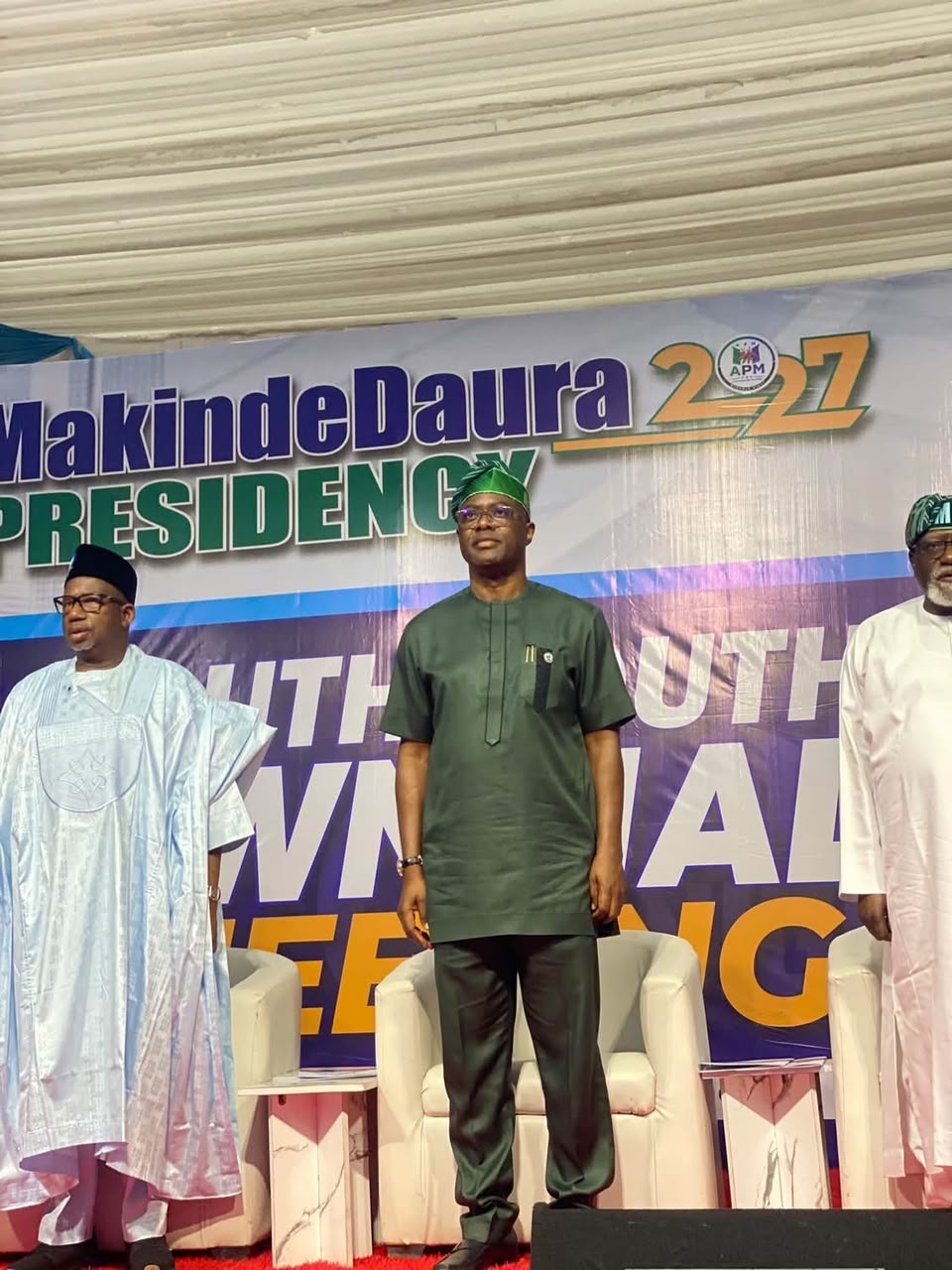
Cites Obasanjo-Falae contest, promises security, economic recovery, national unity
The presidential candidate of the Allied Peoples Movement (APM), Seyi Makinde, has rejected what he described as “turn-by-turn nepotistic government”, insisting that Nigeria’s leadership and distribution of development projects must be determined by competence, fairness and national interest rather than regional entitlement.
Makinde also defended his decision to contest the 2027 presidential election against President Bola Tinubu, despite both politicians coming from the South-West, citing the 1999 contest between former President Olusegun Obasanjo and Olu Falae as evidence that Nigerians should be free to choose from competing candidates from the same region.
Speaking at the APM South-West Town Hall Meeting on Thursday, the Oyo State governor argued that the country’s development should not be held hostage by arguments over which region was entitled to produce the president.
He questioned why his presidential ambition should be considered inappropriate simply because the incumbent president was also from the South-West.
“I have listened to people who have asked us, ‘Seyi, why are you contesting in this election when the South-West already has somebody occupying that seat?’” he said.
Makinde recalled that in the 1999 presidential election, Obasanjo and Falae, both from the South-West, contested against each other, allowing Nigerians across the country to determine the eventual winner.
“As a matter of fact, what the South-West did was to present two of its finest candidates, two of its best, for Nigerians to choose from. Is there anything wrong with doing that this time around?” he asked.
He said the experience demonstrated that presidential elections should be based on candidates’ records, policies and capacity to address national challenges rather than geographical considerations.
The APM candidate maintained that his ambition was driven by the need to establish a governance system that prioritised national development and distributed public resources according to the needs of citizens.
“We do not want turn-by-turn nepotism. We also do not want a situation where someone says, ‘I will execute projects in my zone because it is my turn,’” he said.
Makinde warned that concentrating development projects in the regions of successive leaders could encourage waste, leave projects abandoned and prevent the country from maximising its economic potential.
He said his proposed Reset Nigeria agenda would focus on infrastructure development, economic expansion, improved security and greater opportunities for young people and women.
To demonstrate his approach to governance, the governor highlighted what he described as improved budget performance in Oyo State, saying implementation had risen from between 28 and 30 per cent when he assumed office to more than 70 per cent.
According to him, the improvement resulted from consistent planning, budget discipline and effective implementation.
He said his administration had maintained a January-to-December budget cycle for more than seven years, with budgets generally presented to the State House of Assembly between November and December and implementation commencing on January 1 of the following year.
Makinde contrasted the approach with what he described as uncertainty surrounding the implementation of the Federal Government’s annual budgets.
He also questioned the expenditure involved in the Nigerian Permanent Representative to the United Nations travelling from New York to Abuja to present the UN budget to the President, arguing that such spending required justification.
On economic policy, the governor advocated a system that would enable Nigerians to become productive and generate wealth before being taxed.
“When they are productive, they become prosperous. When they become prosperous, tax their prosperity. Do not tax poverty,” he said.
He argued that a productive economy would expand government revenue sources, reduce dependence on federal allocations and provide a more sustainable path out of poverty.
The APM candidate also called for the remittance of revenues due to state and local governments, including amounts he said were outstanding from arrangements involving the Nigerian Liquefied Natural Gas (NLNG).
He said his broader economic objective was to enable states and local governments to develop independent revenue streams through productive economic activities.
On security, Makinde pledged to overhaul the country’s security architecture, arguing that persistent insecurity continued to restrict businesses, discourage investment and limit economic growth.
He said his administration would seek to create an environment where businesses could operate beyond 8 pm without the fear and uncertainty associated with insecurity.
The governor also criticised what he described as restrictions on opposition parties, insisting that Nigeria’s democratic development depended on political pluralism and the freedom of citizens to choose their leaders.
“There is no democracy in a one-party system,” he said, urging the Federal Government to avoid actions that could create crises for opposition parties.
Makinde cited Oyo State as an example of the political environment he wanted replicated nationally, arguing that political affiliation should not determine the space available to citizens and parties.
He called on voters across the South-West and other geopolitical zones to assess his candidacy on the basis of his policies and record rather than the argument that the presidency should remain with a particular region.
The APM candidate also pledged to establish a transitional government of national unity if elected, saying his administration would seek to reset the country’s political and economic systems.
He urged Nigerians to obtain their Permanent Voter Cards and participate in the 2027 general election, describing the proposed reforms as a collective responsibility.
APM Leaders Back Makinde’s Candidacy
The APM national leader and Bauchi State Governor, Senator Bala Mohammed, defended the party’s decision to nominate Makinde, describing him as an experienced administrator with a record of governance at the state level.
Mohammed said the party’s choice followed research, planning and an assessment of Makinde’s performance in Oyo State, particularly in infrastructure development and public services.
He expressed confidence in the governor’s understanding of Nigeria’s development challenges and his ability to address infrastructure gaps.
The Bauchi governor also stressed the importance of fairness and allowing competing political interests to coexist, describing the APM as an alternative platform for Nigerians seeking a different approach to governance.
He said the South-West town hall meeting was designed to give stakeholders an opportunity to express their expectations ahead of the development and implementation of the party’s policies.
According to him, effective governance requires listening to citizens, accommodating different perspectives and ensuring that public programmes reflect their needs.
The APM vice-presidential candidate, Lawal Daura, said the party’s ticket was committed to addressing Nigeria’s economic and security challenges and reducing the hardship experienced by citizens.
Daura described the reception at the town hall meeting as encouraging, adding that sustained engagement with voters would be essential to communicating the party’s proposals.
He said the proposed administration would begin implementing its priorities after the inauguration of a new government on May 29, 2027, if elected.
“We will not introduce more hardship, frighten the people or leave them confused. Instead, we will work to reduce their pain, alleviate their suffering and make them feel once again that they are truly citizens of Nigeria,” he said.
Daura urged party members to remain focused on the campaign and avoid distractions, adding that the party would respond to unlawful activities through measures permitted by law.
APM National Chairman Yusuf Dantelle said the party’s call for a national reset was driven by concerns over fuel prices, insecurity, the rising cost of living and the state of democratic governance.
Dantelle questioned why Nigerians continued to pay high prices for petroleum products despite the country’s status as a major oil producer, calling for greater transparency in fuel pricing.
He also questioned the effectiveness of existing security measures, including SIM card registration, in preventing kidnappings and attacks.
On democracy, the party chairman expressed concern over what he described as undue interference in opposition politics, calling for greater respect for voters’ choices.
He further raised concerns about the role of legal technicalities in electoral disputes, arguing that public confidence in democratic institutions depended on credible elections and respect for the electorate’s decisions.
Dantelle urged Nigerians to look beyond religion, ethnicity and political affiliation when considering the country’s future, insisting that national development required collective action, accountability and a commitment to public welfare.
The South-West town hall meeting formed part of the APM’s engagements ahead of the 2027 general election, during which party leaders outlined their Reset Nigeria agenda and presented their positions on the economy, security, federalism and democratic governance.