


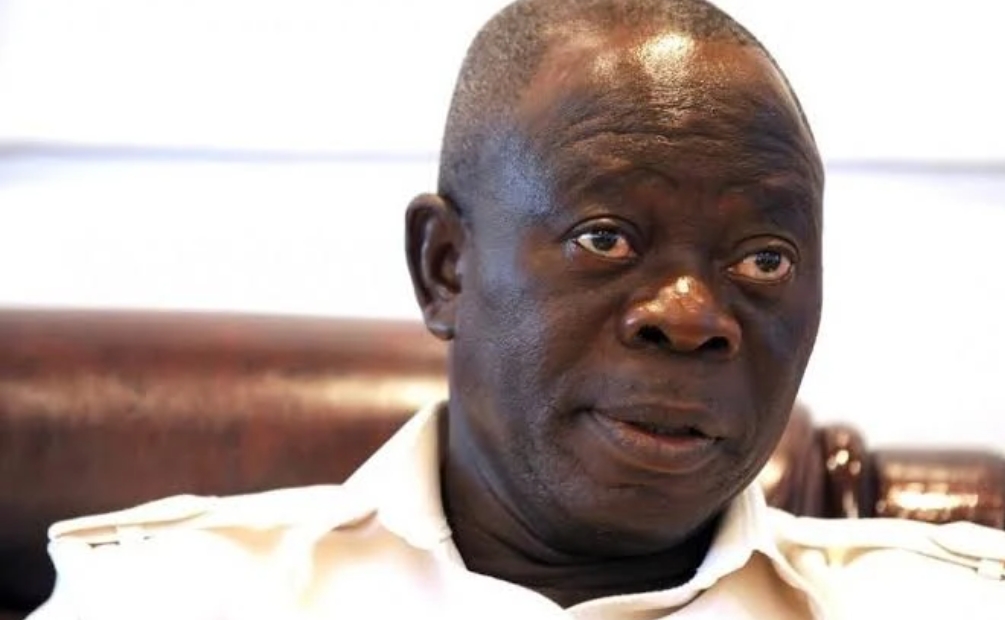
Senator Adams Oshiomhole (APC, Edo North) yesterday stunned the Nigerian Senate when he revealed that hackers gained access to his personal bank account exclusively through two popular fintech platforms, OPay and Moniepoint, without touching any traditional bank.
Speaking during the second reading of the Banks and Other Financial Institutions Act (BOFIA) 2020 (Amendment) Bill, the former labour leader and two-term governor of Edo State used his personal experience to underscore the urgent need for the Central Bank of Nigeria (CBN) to extend stricter supervision to non-bank financial institutions that have grown into systemically important players.
“I was a victim,” Senator Oshiomhole told a hushed chamber. “My account was hacked through OPay and Moniepoint. No single registered bank was involved in the breach. I know the directors of our regular banks, but I don’t know the directors of OPay. I don’t know the directors of Moniepoint.”
The lawmaker warned that the anonymity and rapid growth of some fintech operators were creating dangerous loopholes that cybercriminals were exploiting. “If these institutions collapse tomorrow, it is the government that will bear the burden,” he said, urging his colleagues to “block every possible loophole” in the proposed legislation.
The BOFIA amendment bill, which scaled second reading yesterday, seeks to empower the CBN to regulate and supervise “systemically important non-bank financial institutions,” a category that now includes major fintechs such as OPay, Moniepoint, PalmPay, and Kuda.
Senate President Godswill Akpabio referred the bill to the Senate Committee on Banking, Insurance and Other Financial Institutions for further legislative work, with a directive to report back in four weeks.
Neither OPay nor Moniepoint had issued an official response to Senator Oshiomhole’s claims at the time of filing this report. Both companies are licensed by the CBN and have repeatedly stated that customer funds are insured by the Nigeria Deposit Insurance Corporation (NDIC).
Cybersecurity experts, however, say the incident highlights the growing sophistication of fraudsters who exploit weak Know-Your-Customer (KYC) processes and phishing attacks targeting mobile wallets.
Senator Oshiomhole’s disclosure has reignited the long-running debate over the balance between financial inclusion driven by fintech innovation and the need for robust consumer protection in Africa’s largest economy.
The Senate’s decision to fast-track the BOFIA amendment suggests that tougher rules for Nigeria’s booming fintech sector may be on the horizon.

