


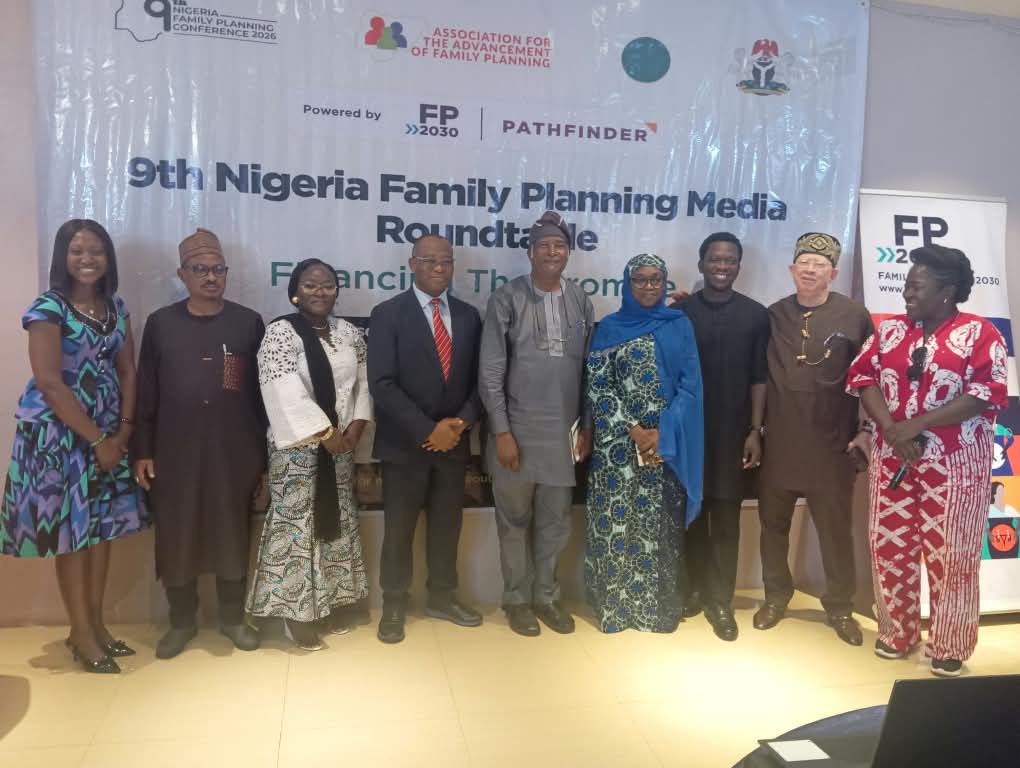
…Media challenged to promote family planning, track government spending
Family planning experts have warned that Nigeria’s population could hit 450 million in the next 25 years, urging government to increase domestic investment, strengthen family planning services and reduce dependence on donor funding.
The experts, led by the Co-founder of the Association for Reproductive and Family Health (ARFH), Prof. Ladipo, said the country’s rising population, high fertility rate and low use of modern contraceptives could undermine national development if urgent measures were not taken.
Speaking on Thursday in Abuja at the 9th Nigeria Family Planning Media Roundtable, themed “Financing the Promise: Domestic Investment, Sustainable Financing and Accountability for Family Planning in Nigeria,” Ladipo called on journalists to intensify public awareness and hold government accountable for its family planning commitments.
He put Nigeria’s population at about 240 million, with an annual growth rate of approximately three per cent and a total fertility rate of 4.8 children per woman.
According to him, modern contraceptive prevalence stands at barely 18 per cent, while about 22 per cent of women have an unmet need for modern contraception.
Ladipo lamented that Nigeria had failed to sustain the progress made by reproductive health advocates in the late 1980s, saying the country could have achieved a much higher contraceptive prevalence rate.
“By now, we should be about 60 per cent modern contraceptive use if we had followed the trajectory and the momentum of that time,” he said.
He described the current level of contraceptive uptake as disappointing, noting that Nigeria had committed to achieving a 27 per cent modern contraceptive prevalence rate by 2030 under the Family Planning 2030 (FP2030) agenda.
Challenging journalists to give family planning sustained attention, Ladipo said the media had the power to influence public behaviour and health-seeking decisions.
“My message is that you need to understand and internalise your pivotal role in this movement because you have not done well,” he told journalists.
He warned that the media would share responsibility if Nigeria failed to meet its 2030 target, adding: “You have the instruments and the power of voice to change people’s behaviour and health-seeking behaviour.”
The ARFH co-founder said uncontrolled population growth would worsen poverty and frustrate development efforts, particularly with about 140 million Nigerians already living in multidimensional poverty.
“If we do not moderate the population growth of Nigeria, this country will never develop. No amount of handouts at the end of the month will solve the problem,” he said.
To address funding challenges, Ladipo proposed innovative financing mechanisms, including additional charges of $20 on international visa applications and $50 on airline tickets, with the proceeds dedicated to reproductive healthcare and family planning.
He said such funds should be independently managed and protected against diversion, while urging journalists to monitor government budgetary allocations and actual releases to the reproductive health sector.
Ladipo also expressed concern over maternal deaths in the country, likening the daily loss of mothers to a passenger aircraft crashing every day with all passengers on board dying.
Earlier, the Chairman of the Association for the Advancement of Family Planning (AAFP) and Chairman of the Local Organising Committee for the 9th Nigeria Family Planning Conference, Dr Ejike Oji, said the forthcoming conference would focus on converting Nigeria’s family planning commitments into sustainable financing and measurable results.
Oji said the conference, scheduled for November 30 to December 4, 2026, in Abuja, was being organised in collaboration with the Federal Ministry of Health and Social Welfare, development partners, donors and civil society organisations.
He disclosed that 546 abstracts were submitted within about three weeks, with 109 oral presentations and 200 poster presentations selected. Discussions would cover domestic resource mobilisation, innovative financing, public-private partnerships, local manufacturing, contraceptive commodity security, equitable access, technology and accountability.
He said the conference was expected to produce a communiqué, a domestic financing roadmap and a mechanism for tracking commitments and implementation.
Oji urged journalists to distinguish between budget announcements, pledges, confirmed commitments, actual fund releases and results achieved. He also called for wider coverage of the experiences of women, young people, persons with disabilities, healthcare workers and other stakeholders.
Also speaking, the Regional Portfolio Director for West and Central Africa and Country Director of Pathfinder International, Dr Amina Aminu Dorayi, called for stronger domestic financing and accountability to sustain family planning programmes amid changing development assistance priorities.
Dorayi said Nigeria must not allow funding constraints to reverse progress in family planning, stressing that commitments would have little impact if contraceptives were unavailable, trained health workers were lacking and women and girls could not access services.
“Commitments on paper do not automatically translate to progress. They do not translate to having contraceptives available at health facilities, having trained providers present, and having women and girls and families being able to access the services they need,” she said.
She described family planning as an investment in human capital, women’s economic empowerment, education, household resilience and national development, adding that domestic resource mobilisation was essential as countries could no longer assume that external funding would always be available.
Dorayi also advocated stronger public-private partnerships, saying government must ensure that allocated funds were released, properly spent and translated into services and commodities reaching women and girls.
She urged journalists to follow the money across federal, state and local government levels, asking them to investigate whether budgetary commitments were producing tangible results.
The Regional Director for West and Central Africa at FP2030, Dr Alain Damiba, also urged Nigeria to reduce its dependence on donor-supported family planning programmes and develop a sustainable funding system involving government, health insurance mechanisms, private-sector actors and domestic institutions.
Damiba called for dedicated family planning budget lines, increased funding for contraceptive procurement, improved last-mile distribution and stronger primary healthcare services.
He said funding should also be diversified through health insurance and Universal Health Coverage schemes, state government co-financing, domestic philanthropy and public-private partnerships.
According to him, accountability should go beyond budget allocations to include timely releases, transparent procurement, actual expenditure, commodity availability and improved access to services.
Damiba cited Burkina Faso, Senegal and Togo as examples of countries that had institutionalised family planning budget lines and mobilised additional resources through partnerships and stakeholder roundtables.
He urged the media to track the entire financing process, from budget approval to fund release, expenditure and delivery of services, noting that commitments should be measured by the results women and girls experience in their communities.
Also speaking, the Director of Population Management and Development Department at the National Population Commission, Dr Kehinde Seun-Addie, said Nigeria could only harness its demographic dividend through deliberate investments in family planning, health, education, skills acquisition, employment and youth participation in governance.
Seun-Addie explained that the demographic dividend represented the economic growth potential that could arise when the working-age population outnumbers dependants, but warned that the opportunity would not automatically translate into development without conscious government action.
He said the NPC was responsible for generating, analysing and disseminating demographic data to guide national planning, resource allocation and policy formulation, stressing the need for collaboration among government agencies, development partners, civil society organisations and the media.
He urged journalists to use reliable population data to promote informed decisions and adapt family planning messages to local languages and cultural realities, noting that some communities responded better to the expression “child spacing” than “family planning.”
Speaking on behalf of young people, Philip Idoko said more than 600 youths submitted essays expressing interest in participating in the forthcoming Nigeria Family Planning Conference.
He said the submissions demonstrated that young people were willing to contribute to family planning discussions and help shape policies affecting their reproductive health and future.
Idoko urged stakeholders and the media to recognise young people as active participants in family planning conversations and create opportunities for their voices to influence programmes and decisions.