


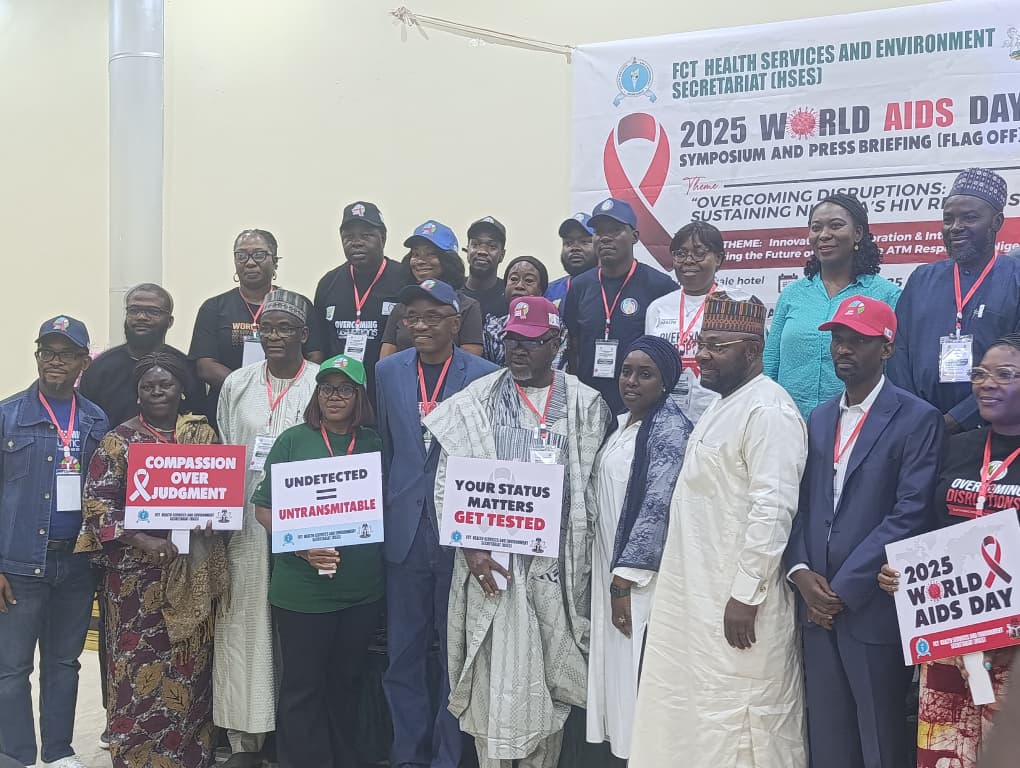
AIDS Fight Must Reach Rural Communities, Says IHVN FCT Regional Manager
…as FCTA Rallies Stakeholders on World AIDS Day 2025
The Regional Manager of the Institute of Human Virology Nigeria (IHVN) for the Federal Capital Territory, Dr. Tangkat Hosle, has urged government at all levels to strengthen community ownership and sustain innovations in the nation’s HIV response, warning that Nigeria risks missing the target of ending AIDS as a public health threat by 2030 without deeper grassroots engagement.
Speaking at the FCT Integrated Symposium for World AIDS Day 2025, Hosle said the commemoration held under the theme “Overcoming Disruptions: Sustaining Nigeria’s HIV Response” and sub-theme “Innovation, Collaboration and Integration: Securing the Future of HIV and the ATM Response in Nigeria” offers a timely opportunity to review progress and renew commitment to controlling HIV/AIDS.
“I want to appreciate the government of Nigeria for this opportunity to mark this very wonderful day, the World AIDS Day 2025. This provides an opportunity for us to review our interventions and look at how far we’ve gone,” he said.
Hosle stressed that innovation and sustainability remain central to keeping HIV services uninterrupted, especially for people living with HIV (PLHIV).
“This topical area helps each and every one of us and PLHIVs to take ownership of the HIV response. From the national down to the local government levels, sustainability allows us to contribute meaningfully to controlling HIV/AIDS,” he said.
He reaffirmed IHVN’s commitment to deepening collaboration with government, strengthening health systems, and advancing modern treatment and prevention methods.
While acknowledging remarkable progress, he cautioned that HIV/AIDS still disproportionately affects vulnerable populationsparticularly the poor, women and children despite the transformation of HIV from a fatal illness into a manageable chronic condition.
Mandate Secretary of the FCT Health Services and Environment Secretariat, Dr. Adedolapo Fasawe, represented by the Permanent Secretary, Dr. Babagana Adams, said no HIV intervention would be fully effective unless rural populations are prioritised.
“The people who need the message more are in the communities,” she said.
“We can’t succeed in sustaining the campaign against AIDS without going closer to the rural areas.”
Fasawe said this year’s theme underscores the need to mobilise local resources to close funding gaps while ensuring that people living with HIV do not face additional barriers.
She identified insecurity, limited access to certain communities, and persistent stigma as major constraints to HIV control in the FCT.
“The government is committed to ensuring access, affordability and availability so that treatment success rates improve,” she added.
Director of the FCT Department of Public Health, Dr. Dan Gadzama, said a First-Class Committee has been established to intensify grassroots mobilisation across all six area councils.
“We educate people about HIV, including the availability of treatment and preventive services. Treatment is free,” he said.
He noted that community mobilisers, PLHIV support networks and civil society groups were working closely to expand awareness and service uptake.
Gadzama confirmed that although external support particularly from the United States has declined, the FCT is shifting its focus to mobilising domestic resources to sustain the HIV response.
“With dwindling funding, it is important that programmes like malaria, tuberculosis and other health services are integrated to minimise cost and ensure wider access,” he explained.
According to him, global innovations including monthly long-acting injectable drugs for HIV prevention are helping countries maintain service delivery despite funding disruptions.
Responding to calls for more community-level engagement, Gadzama said field activities had already begun and would continue across the area councils throughout the week.
“As a matter of fact, activities started in all the area councils on Sunday and will continue till Friday. This event is simply for key stakeholders to dialogue on ways to close gaps in HIV services,” he said.
He assured that the FCT Administration would continue working with local and international partners to ensure no community is left behind in the fight against HIV/AIDS.

