


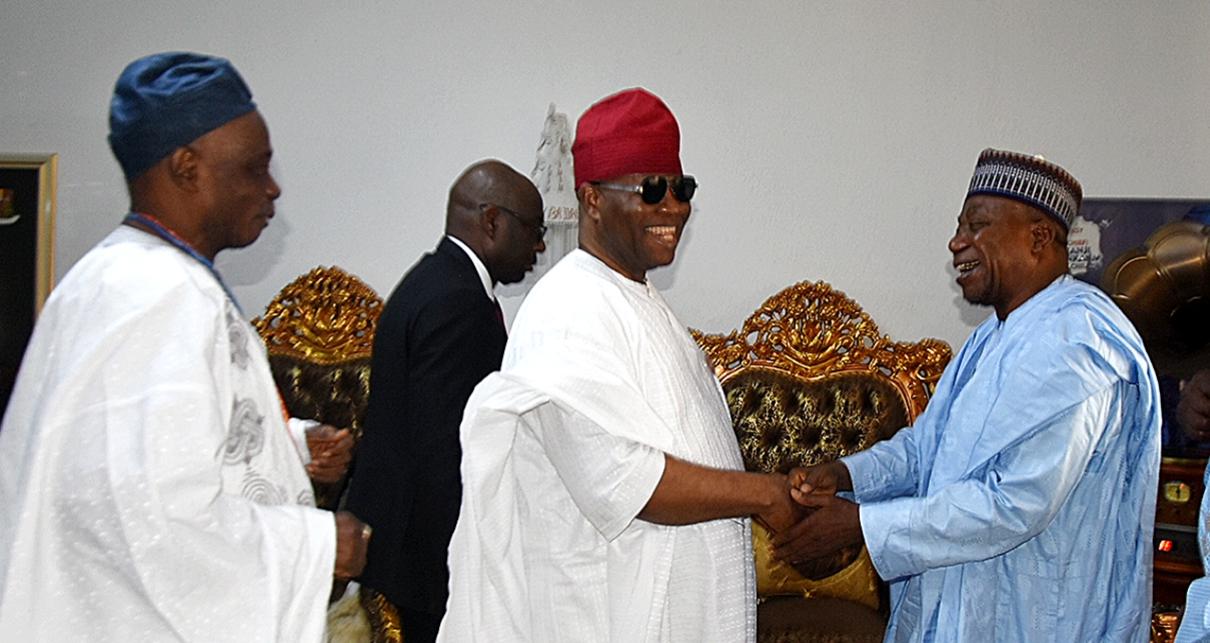
Senate President Endorses Demand During Symbolic Visit to Olubadan
In a development that has re-energised long-standing agitation for the creation of Ibadan State, Senate President Godswill Akpabio has described the demand as “legitimate and popular,” assuring stakeholders that the matter will receive serious attention on the floor of the National Assembly.
The high-powered endorsement came on Sunday during a courtesy visit to the private residence of the newly installed 44th Olubadan of Ibadanland, Oba Rashidi Adewolu Ladoja, at Bodija, Ibadan. Accompanied by a delegation of senior senators — including Adamu Aliero, Yahaya Abdullahi, and Sarafadeen Ali — Akpabio delivered what many in Oyo State are interpreting as the strongest signal yet from the 10th Senate on the viability of carving out a new state from the present Oyo.
“Ibadan is an incoming state,” Akpabio declared bluntly. “It is one of the states whose creation is being demanded by the people.” He added that the issue would be thoroughly examined when constitutional amendment processes resume.
The visit carried extra symbolic weight given the timing: it came barely weeks after Oba Ladoja’s coronation and his public reiteration of the Ibadan State demand during his installation ceremony, where he personally presented the request to President Bola Tinubu.
Oba Ladoja wasted no time in using the occasion to press home the agitation. “My subjects have given me the mandate to represent their interests on all issues, including the creation of Ibadan State,” the monarch said. “I placed this request before President Bola Tinubu during my installation ceremony, and I am repeating it today. My people want Ibadan State, and I appeal to you to use your office to ensure its actualisation.”
The Olubadan also broadened his appeal, calling for constitutional safeguards to protect traditional rulers from arbitrary removal by state governors. “If there is a need to amend the constitution, it should be done to strengthen and protect the traditional institution,” he urged.
Akpabio, in turn, showered praise on the monarch, describing Oba Ladoja — a former senator and governor of Oyo State — as “a blessing not only to Ibadanland but to the entire South-West region.” He highlighted the monarch’s track record as a nationalist, politician, entrepreneur, and administrator, predicting that his reign would bring “remarkable progress” and “innovation” to the traditional institution.
The Senate President’s choice of words — “Ibadan is an incoming state” — is likely to be seized upon by pro-Ibadan State campaigners as the most explicit backing the cause has received from the leadership of the National Assembly in recent years.
For context, the agitation for Ibadan State dates back decades, rooted in the city’s historical size, population density, economic weight, and sense of marginalisation within the larger Oyo State structure. Proponents argue that Ibadan, one of Nigeria’s most populous and culturally significant cities, deserves statehood in its own right, with the proposed capital at Ibadan itself.
Yet the path to state creation remains notoriously difficult. Any new state would require a constitutional amendment — a process that demands two-thirds approval in both chambers of the National Assembly and ratification by at least two-thirds of state Houses of Assembly nationwide — a high bar that has frustrated similar demands in the past.
Akpabio’s visit and endorsement, however, inject fresh political momentum at a time when the Tinubu administration has signalled openness to constitutional reforms in other areas. Whether that openness extends to the politically sensitive question of new states — especially one that would alter the balance of power in the South-West — remains to be seen.
For now, the Senate President has raised expectations sky-high. Ibadan’s advocates are already framing Sunday’s encounter as a turning point: the day the number three citizen in the land publicly declared their dream state “incoming.”
The real test will come when the constitutional amendment process formally begins. Until then, Ibadan watches, waits — and hopes.

