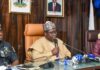
…Says don’t entrust your destiny to ‘kalokalo’ people
Minister of the Federal Capital Territory (FCT), Nyesom Wike, has taken a swipe at former Vice President Atiku Abubakar, former Rivers State governor Rotimi Amaechi and Labour Party’s 2023 presidential candidate, Peter Obi, describing them as political gamblers ahead of the 2027 general elections.
Wike warned the people of Rivers State against entrusting their political future to politicians he accused of pursuing presidential ambitions without a clear vision for the country.
The minister spoke during a Rainbow Coalition town hall meeting in Ayama, Abua/Odual Local Government Area of Rivers State, where he mobilised support for President Bola Tinubu’s re-election bid in 2027.
Addressing traditional rulers, party faithful and community stakeholders, Wike urged Nigerians to judge political leaders by their records in public office, developmental achievements and capacity to deliver on their promises.
“Don’t trust your destiny to political gamblers. Don’t trust your destiny to ‘kalokalo’ people,” he declared.
The FCT minister specifically mentioned Atiku, Amaechi and Obi, insisting that Nigerians should not surrender their future to politicians who repeatedly seek the presidency without convincing plans to address the country’s challenges.
“These people are political gamblers and you cannot give your destiny to ‘kalokalo’ people; you cannot hand over your destiny to political gamblers.
“Give a destiny to somebody who we know, who has tried all this, and he has done it,” Wike said.
He argued that repeated presidential contests did not automatically make a politician capable of governing the country, insisting that leadership should be based on a demonstrable record of performance and a clear development agenda.
Wike also challenged Amaechi to showcase his contributions to Abua/Odual, urging residents to assess political leaders based on projects delivered to their communities rather than campaign promises.
Defending his record as Rivers State governor, the minister maintained that tangible development should guide the people’s political decisions.
He also praised President Tinubu’s administration for what he described as efforts to stabilise critical sectors of the economy and restore industrial harmony in tertiary institutions.
Wike urged the people of Abua/Odual to support Tinubu and other candidates endorsed by the Rainbow Coalition in the 2027 elections.
He called on residents to vote for Tinubu for president, Kingsley Chinda for governor, Felix Obua for Rivers West Senatorial District and Solomon Boss for the Abua/Odual-Ahoada East Federal Constituency, all under the All Progressives Congress (APC).
He also urged the electorate to support John Iderima, the Peoples Democratic Party (PDP) candidate for the Abua/Odual State Constituency.
Speaking at the gathering, Chinda commended Wike for his grassroots mobilisation efforts, saying the approach would be sustained if he emerged governor.
“This is a system that we will sustain when we come into government. We have learnt from him, and we will continue.
“It will be a bottom-up approach; the people will decide and determine their fate in government,” he said.
Earlier, Professor Continue Eketu, who spoke on behalf of the Abua/Odual communities, described Wike as his political idol and highlighted projects he said were executed in the local government area during the minister’s tenure as governor.
Eketu praised Wike’s leadership and declared that the communities had resolved to vote for candidates endorsed by the Rainbow Coalition.
The Aig-Imoukhuede Foundation, a philanthropic organisation focused on strengthening public sector leadership development across Africa, brought together public sector leaders, alumni and reform stakeholders in Lagos for its 2026 Public Sector Reform Convening, themed “Unblocking Reform: From Design to Delivery” on 14 October.
The event builds on the Foundation’s ongoing work with its alumni network, a growing community of public sector reform leaders across the continent, and draws on an analysis of alumni reform projects, which identified stakeholder engagement, communication, organisational culture and collaboration as key factors shaping implementation success.
Speaking at the event, Ofovwe Aig-Imoukhuede, Executive Vice Chair of the Aig-Imoukhuede Foundation, emphasised that successful reform depends on understanding the institutional realities that shape implementation and building the support needed to sustain change.
“This is not to suggest that every objection to reform is unreasonable or that resistance can simply be overcome through better communication. Rather, effective reform leadership requires an understanding of institutional contexts, a willingness to listen to those affected and a deliberate effort to build the support necessary for implementation.”
The programme featured a keynote by Olabode Shuageeb Agoro, Lagos State Head of Service, a panel on “Advancing Reform: Building Buy-In and Coalitions,” and an in-conversation session with experienced reform leaders, all focused on stakeholder engagement, communicating change and sustaining reform over time.
Agoro highlighted the importance of addressing the underlying challenges that hinder reform implementation, noting that resistance may stem from gaps in skills, resources or understanding.
“A capacity gap cannot be resolved by repeating an instruction. Leaders must communicate the purpose of reforms, align institutions around their objectives, provide the resources and capabilities required for implementation, and ensure that accountability continues long after implementation. People always feel better if they are carried along. Nobody wants to feel that they don’t matter. So it is always important to engage at all levels.”
Participants also took part in an interactive Reform Reality Check and a Reform Solutions Lab, working in multidisciplinary groups to develop practical approaches to organisational support, stakeholder engagement and collaborative action, identifying actions they could adapt to their own institutions.
The convening is part of the Foundation’s broader effort to position its alumni network as a platform for peer learning, strategic dialogue and collaboration among public sector reform leaders, ultimately helping to ensure that reforms are not only well designed , but implemented in ways that translate into better outcomes for citizens.
The Economic and Financial Crimes Commission (EFCC) and the National Judicial Institute (NJI) have called for legal and procedural reforms to tackle delays, abuse of court processes and other challenges hindering the speedy trial of corruption and financial crime cases in Nigeria.
The agencies also called for the designation of specialised judges and court officials to handle corruption cases, alongside improved training and technological support to strengthen the administration of justice.
The resolutions were contained in a communiqué issued at the end of the 8th Capacity Building Workshop for Justices and Judges, held in Abuja from October 13 to 15, 2026.
The workshop, organised by the EFCC in collaboration with the NJI, had as its theme, “Investigation and Prosecution of Economic and Financial Crimes in a Digital Age.”
It brought together judicial officers from across the country, as well as EFCC investigators and prosecutors, to examine emerging challenges in the investigation and prosecution of economic and financial crimes.
In the communiqué, participants said delays in corruption trials could be significantly reduced by assigning specialised judges and court staff to handle such cases and equipping them with the necessary skills to ensure the efficient and consistent application of existing laws.
They also called for a proper balance between protecting individual rights and ensuring the speedy administration of justice.
To achieve this, the participants recommended a review of relevant provisions of the Administration of Criminal Justice Act (ACJA), where necessary, to address procedural bottlenecks and improve the efficiency of criminal proceedings.
On investigations and prosecutions, the participants urged investigative and prosecutorial agencies to strengthen their standards, particularly in digital evidence management, to ensure that cases are built on credible, reliable and admissible evidence.
They also advocated a more coordinated approach to obtaining confessional statements, recommending institutionalised video recording and other safeguards to protect suspects’ rights and preserve the integrity of investigations.
AI, Digital Evidence Under Scrutiny
The communiqué further highlighted the need for clear regulations governing the use of artificial intelligence (AI) in the administration of justice.
Participants recommended that ministries, departments and agencies involved in the anti-corruption campaign, working with the National Assembly and the judiciary, should develop governance protocols and policy guidelines for adopting and deploying AI in the justice system.
They also called for increased investment in digital forensic laboratories, technology infrastructure and specialised training for investigators, prosecutors and judicial officers.
On the use of open-source intelligence, the participants advised investigators, prosecutors and judicial officers to treat such information primarily as a source of investigative leads and corroboration, while ensuring that any evidence presented in court complies with applicable evidential rules.
The workshop also examined the growing importance of virtual assets in financial crime investigations.
Participants urged relevant stakeholders to familiarise themselves with existing laws governing the investigation, prosecution and adjudication of cases involving virtual assets.
The laws and instruments identified included the Investment and Securities Act 2025, the Executive Order on Virtual Assets Coordination 2026, the Rules on Digital and Virtual Assets Operations 2026 and the Proceeds of Crime Act 2022.
EFCC, NJI Back Asset Recovery
The participants described non-conviction-based asset forfeiture as an effective instrument for recovering stolen assets but stressed that its application must comply with existing legal procedures, human rights standards and strong institutional oversight.
They also called for procedural reforms to provide for extensions of time for freezing suspected proceeds of financial crimes.
On capacity building, the communiqué recommended continuous and specialised training for judicial officers and anti-corruption agency personnel to equip them with the knowledge and skills required to tackle evolving financial crimes in line with global best practices.
Participants further recommended that the NJI, in collaboration with the National Judicial Council (NJC), develop accredited certificate and diploma programmes to improve the competence and efficiency of judges and other stakeholders in the administration of justice.
They urged heads of courts to use the lessons from the workshop to develop policies clarifying judicial practice on the technical issues discussed.
The communiqué also called for sustained cooperation and information-sharing among institutions involved in criminal justice administration, particularly on emerging trends in the investigation and prosecution of economic and financial crimes in the digital age.
The three-day workshop featured nine interactive sessions covering the admissibility of confessional statements, reforms to garnishee proceedings, delay tactics and abuse of court processes, non-conviction-based forfeiture, artificial intelligence in investigations and prosecutions, virtual asset recovery and management, and the use of digital forensics in financial crime cases.
Justices of the Supreme Court and Court of Appeal, judges of the Federal High Court, state high courts and the FCT High Court, alongside other stakeholders in the judiciary and anti-corruption agencies, attended the workshop.
Participants expressed appreciation to President Bola Ahmed Tinubu, who was represented by Vice-President Kashim Shettima, as well as the organisers and other stakeholders who contributed to the workshop’s success.Tags
EFCC, National Judicial Institute, NJI, Corruption Trials, Legal Reforms, Economic and Financial Crimes, Administration of Criminal Justice Act, ACJA, Digital Forensics, Artificial Intelligence, Asset Forfeiture, Virtual Assets, Nigerian Judiciary, Anti-Corruption Campaign, Justice Delivery
A Federal High Court in Abuja has sentenced two men arrested by the Department of State Services (DSS) to life imprisonment for supporting the proscribed Boko Haram terrorist group.
The convicts, Abba Mustapha and Bukar Ibrahim, both indigenes of Borno State, were sentenced after pleading guilty to charges bordering on providing support to the terrorist organisation and concealing information about its activities.
Delivering judgment, Justice Salim Ibrahim sentenced each defendant to life imprisonment on the first count and 20 years’ imprisonment on the second count.
The sentences were handed down during the Federal Government’s latest phase of mass trials of suspected terrorists at the Federal High Court.
The exercise, which commenced on Thursday, is being conducted across several courtrooms as the government continues the prosecution of individuals accused of involvement in terrorism-related activities.
Other judges handling the proceedings include Justices James Omotosho, Binta Nyako, Emeka Nwite, Obiora Egwuatu, Hauwa Yilwa, Joyce Abdulmalik and Peter Lifu.
At least 34 suspects were listed for proceedings before Justice Ibrahim, while 25 others were scheduled to appear before Justice Lifu.
The mass trials form part of the government’s efforts to prosecute terrorism-related cases and hold individuals found guilty of supporting terrorist organisations accountable under the law.Tags
Boko Haram, DSS, Department of State Services, Terrorism Trial, Life Imprisonment, Federal High Court Abuja, Abba Mustapha, Bukar Ibrahim, Justice Salim Ibrahim, Terrorism in Nigeria, Mass Trials of Terrorism Suspects, Nigeria Security
The Independent National Electoral Commission (INEC) has moved to tackle late arrival of election materials at polling units ahead of the 2027 general election with the inauguration of a multi-agency Electoral Logistics Committee.
The committee is expected to strengthen coordination among relevant government agencies, identify potential transportation challenges and ensure the timely delivery of sensitive and non-sensitive election materials across the country.
INEC Chairman, Prof. Joash Amupitan, inaugurated the committee as part of efforts to address persistent logistical problems that have disrupted voting in previous elections and raised concerns among voters and election observers.
The committee is chaired by INEC National Commissioner, Rear Admiral Jamila Malafa (rtd), and comprises representatives of government agencies and organisations responsible for transportation, security and logistics.
Its mandate includes assessing the commission’s logistical needs, auditing warehouses, vehicles and transportation hubs, identifying potential risks and coordinating the movement of election materials through road, air and maritime routes.
The committee will also collaborate with relevant agencies to improve operational efficiency and ensure that logistical arrangements conform to the commission’s electoral timetable.
Its membership includes representatives of the Nigeria Police Force, Nigerian Correctional Service, Central Bank of Nigeria, aviation and airport authorities, port operators, Nigeria Security and Civil Defence Corps, Nigeria Customs Service, road transport unions and the Maritime Workers Union.
The involvement of the agencies is expected to strengthen inter-agency cooperation and address the transportation, security and operational challenges associated with conducting a nationwide election.
Timely deployment of election materials is particularly important in remote communities and areas with difficult terrain, where transportation difficulties could delay the commencement of voting.
INEC’s latest move comes as the commission intensifies preparations for the 2027 general election.
According to its latest bulletin, nine of the 14 statutory activities outlined in the electoral timetable had been completed as of October 15, 2026.
The commission also disclosed that the national voter register had exceeded 103 million, highlighting the scale of the preparations required for the forthcoming election.
With 176,846 polling units spread across the country, INEC faces the task of coordinating the movement of election materials and personnel to thousands of locations within a limited period.
The commission has also continued engagements with relevant institutions on voter participation, electoral integrity and public confidence in the electoral process.
Among the measures highlighted by INEC are the Bimodal Voter Accreditation System (BVAS) and the INEC Result Viewing Portal (IReV), alongside efforts to protect ballot secrecy and strengthen collaboration with law enforcement and anti-corruption agencies through the Inter-Agency Consultative Committee on Election Security.
The Electoral Logistics Committee is expected to identify operational gaps early and recommend measures to ensure that the necessary resources and transportation arrangements are in place before election day.
INEC has faced criticism over delays in the commencement of voting during previous elections, with the late arrival of personnel and election materials frequently cited as a major concern by voters and election observers.
The effectiveness of the new committee will therefore be measured by its ability to translate its recommendations into practical arrangements that guarantee timely deployment and reduce avoidable delays at polling units.
As preparations for the 2027 general election gather momentum, the commission’s logistics strategy will be crucial to ensuring that eligible voters can exercise their franchise without unnecessary delays.Tags
INEC, 2027 General Election, Electoral Logistics Committee, Joash Amupitan, Jamila Malafa, Election Materials, Late Arrival of Election Materials, Nigeria Elections, BVAS, IReV, Voter Register, Electoral Commission, Election Preparation.
.The High Court of the Federal Capital Territory (FCT), Abuja, has fixed November 9, 10 and 13, 2026, for the commencement of trial in the ₦15 billion defamation suit filed by Femi Gbajabiamila, Chief of Staff to President Bola Tinubu, against Adeniyi Adeyemi, Director-General of the Presidential Foreign Intervention Promotion Council (PFIPC).
Justice Samira Bature fixed the dates on Thursday following a disagreement between lawyers over an application by Adeyemi’s counsel for an extension of time to file his defence.
At the resumed hearing, Kemi Pinheiro and Olukayode Enitan, counsel to Gbajabiamila, opposed the application filed by M.P. Usman, who represents Adeyemi.
Usman told the court that he filed a memorandum of appearance on October 14 and needed additional time to respond to the suit.
However, Pinheiro argued that Adeyemi had been served with the court processes on July 30, 2026, and that the time allowed for filing his defence had expired in September.
He urged the court not to allow further delays, stressing that the integrity of a public officer was at stake.
Gbajabiamila’s lawyers also requested three separate dates to enable their client to present and conclude his case.
Granting the request for a definite hearing schedule, Justice Bature fixed November 9, 10 and 13 for the trial.
Neither Gbajabiamila nor Adeyemi was present in court.
While Pinheiro and Enitan appeared for the claimant, Jamiu Agoro and Chioma Olisakwe were also present on his legal team. Usman represented the defendant.
The suit arose from allegations by Adeyemi that Gbajabiamila demanded a 48 per cent kickback from a reported ₦27.3 billion take-off grant allegedly approved for the PFIPC, an organisation the Presidency has disowned.
Adeyemi reportedly made the allegations at a press conference on June 25, 2026, according to an earlier report by TheCable.
He also alleged that Gbajabiamila received ₦400 million through a proxy in connection with the organisation.
On July 7, 2026, Gbajabiamila, through his lawyers, issued a cease-and-desist letter demanding that Adeyemi withdraw the allegations, remove related videos and publications, and publish a retraction and apology in at least five national newspapers and on the social media platforms where the claims were circulated.
Gbajabiamila subsequently instituted the ₦15 billion suit, seeking ₦10 billion in general damages, ₦5 billion in aggravated damages and ₦200 million as the cost of the action.
He is also asking the court to compel Adeyemi to publish a full retraction and an unconditional apology in five national newspapers and on the affected social media and online platforms for 30 consecutive days.
In his statement of claim, Gbajabiamila denied ever meeting or speaking with Adeyemi, insisting that he had never authorised anyone to demand or collect money on his behalf.
He also denied demanding any percentage of the alleged grant or receiving money, either directly or indirectly, from Adeyemi.
The court is expected to begin hearing evidence in the matter on November 9.Tags: Femi Gbajabiamila, Adeniyi Adeyemi, ₦15bn Defamation Suit, FCT High Court, Samira Bature, Presidential Foreign Intervention Promotion Council, Bola Tinubu, Abuja Court, Defamation Case, Nigeria Judiciary
Tragedy struck Oluku community along the Benin-Lagos Highway in Ovia North-East Local Government Area of Edo State on Thursday after a petrol tanker exploded, leaving four persons feared dead, several others injured and properties worth millions of naira destroyed.
A military personnel was among the reported victims, while several people sustained varying degrees of injuries and burns in the inferno.
The explosion also destroyed several vehicles and razed a nearby market belonging to popular businessman, Chief Osamede Adun, popularly known as Bob Izua.
The incident reportedly occurred after the tanker, laden with Premium Motor Spirit (PMS), fell on the highway, prompting residents and passers-by to rush to the scene to scoop fuel.
An iron container was said to have ignited the fire, which quickly spread across the area, engulfing vehicles, shops and other properties.
An eyewitness, who owns a shop opposite the scene, said efforts by security personnel to prevent residents from scooping fuel from the fallen tanker proved unsuccessful.
“It was when they were scooping fuel that the fire started. It spread to the Bob Izua market along the road.
“Many cars were affected in the incident because the fire spread quickly. We have counted four persons that died. One soldier is among the dead,” the eyewitness said.
Ten persons who sustained severe burns were reportedly rushed to the University of Benin Teaching Hospital (UBTH) for emergency treatment.
One of the survivors, who requested anonymity, said he narrowly escaped death after a soldier warned him about the danger of scooping fuel under the scorching sun.
“I was also among those who were scooping the fuel. I escaped by whiskers. It was a soldier who called me and drew my attention to the fact that it was sunny and the way the people rushed to scoop the fuel might ignite fire.
“As I looked back after he spoke to me, the tanker burst into flames as people around the area ran for their lives. I thank the soldier; if not, I would have been burnt by now,” he said.
The survivor added that two men from northern Nigeria who were directly beneath the tanker were burnt in the incident.
He also disclosed that shops built along the drainage and other nearby stores were destroyed by the fire, while the exact number of casualties remained uncertain.
According to him, 10 injured persons were taken to the emergency unit of UBTH for treatment.
Meanwhile, the hospital management swiftly mobilised its emergency response team to attend to the victims.
The Chief Medical Director of UBTH, Prof. Idia Ize-Iyamu, personally coordinated the emergency response, leading medical teams across the accident, emergency and burns units to stabilise severely injured victims and minimise fatalities.
The incident has once again highlighted the dangers associated with scooping fuel from fallen tankers, an activity that frequently exposes residents and passers-by to potentially fatal fires and explosions.Tags
Edo State, Tanker Explosion, Oluku, Benin-Lagos Highway, Four Feared Dead, Petrol Tanker Fire, Fuel Scooping, University of Benin Teaching Hospital, UBTH, Idia Ize-Iyamu, Osamede Adun, Bob Izua Market, Road Accident, Fire Disaster, Nigeria News
The National Sports Commission (NSC) has unveiled an ambitious plan to create at least two million jobs and raise sports’ contribution to Nigeria’s Gross Domestic Product (GDP) to three per cent, as part of efforts to transform the sector into a major driver of economic growth.
NSC Chairman, Shehu Dikko, disclosed this on Thursday during the inauguration of the boards of four sports federations at the Moshood Abiola National Stadium, Abuja.
Dikko said the commission was shifting attention from the traditional emphasis on medals and competitions to building a commercially viable sports industry capable of attracting investment, creating employment and improving livelihoods.
He said the strategy, known as the Renewed Hope Initiative for the Nigerian Sports Economy, was designed to unlock the sector’s economic potential and create sustainable opportunities for athletes, coaches, administrators and other professionals.
According to him, the commission has identified more than 28,000 jobs associated with sports, covering direct, indirect and induced employment, as part of efforts to demonstrate the industry’s capacity to generate wealth.
The NSC chairman also disclosed that Nigeria won 375 medals across various sports at international competitions in 2025, describing the achievement as unprecedented.
He charged the newly inaugurated federation boards to align their programmes with the commission’s vision by strengthening grassroots development, improving administration, investing in infrastructure and creating clear pathways for athletes to compete internationally.
“If the federations succeed, we succeed,” Dikko said, stressing the need for cooperation between the commission and the federations to achieve sustainable progress.
On infrastructure development, he revealed that the commission had secured presidential approval to establish a sports infrastructure development bond, with plans to raise more than ₦1 trillion in an initial phase through the capital market.
The proposed financing mechanism is expected to support the development and rehabilitation of sports facilities, improve talent development and create opportunities to attract major competitions and private investment.
Beyond sporting competitions, the initiative is expected to stimulate employment in facility management, event organisation, broadcasting, merchandising, sports medicine, marketing and sports tourism.
Benson Unveils Padel Development Plan
Meanwhile, the newly inaugurated President of the Nigeria Padel Federation, Hon. Babajimi Benson, has unveiled plans to attract investment, establish training academies and develop infrastructure to position padel as a major sporting attraction in Nigeria.
Benson, who chairs the House of Representatives Committee on Defence, said the federation would focus on effective governance, grassroots participation and professional opportunities for young Nigerians.
He explained that his decision to lead the federation was informed by the opportunities the fast-growing sport offered Nigerian youths, particularly their athletic abilities and potential to excel.
According to him, padel offers career opportunities beyond professional playing, including coaching, club management, sports administration and participation in national and international competitions.
“Padel gives them a platform whereby they can grow and gives them opportunities to either be into coaching, being in clubs, representing the country, representing their clubs and participating in international events,” he said.
Benson said Nigeria must position itself to benefit from the sport’s international growth rather than allow other countries to dominate its development.
“Nigeria must not simply watch that growth happen. Nigeria must be part of it, and ultimately, lead it in Africa,” he said.
He identified four priorities for the federation: expanding participation, developing talent, establishing a world-class competitive structure and building a sustainable organisation anchored on sound governance.
To broaden participation, Benson said the federation would work to increase the number of players, clubs and courts while expanding the sport beyond Lagos, Abuja and Port Harcourt to other parts of the country.
Schools, universities, corporate organisations and local communities would also be encouraged to embrace the sport.
On talent development, he said the federation would establish pathways for junior players, women, girls and high-performance athletes, while investing in the training of coaches, referees and tournament officials.
The federation also plans to introduce national competitions, rankings and championships, alongside stronger collaboration with the International Padel Federation and African partners to bring Nigerian players and officials in line with international standards.
Benson expressed the ambition to make Nigeria a destination for major padel competitions, noting that this could create opportunities for athletes, clubs, investors and other players in the sports industry.
He, however, stressed that achieving these goals would require sound governance, reliable data, technology, strategic partnerships and a sustainable commercial model capable of attracting sponsors and private investors.
“Sport cannot thrive on enthusiasm alone. We need strong governance. We need technology and reliable data. We need partnerships. And we need a sustainable commercial model,” he said.
NSC Charges Federations on Good Governance
Also speaking, NSC Director-General, Hon. Bukola Olopade, urged sports federations to embrace unity, sound administration and peaceful dispute resolution, describing cooperation as essential to the development of Nigerian sports.
Olopade commended the new leadership of the Nigeria Basketball Federation for conducting a peaceful election despite previous controversies within the federation.
He said the commission had continued to intervene in disputes affecting sports administration, citing disagreements involving judo and football as examples of efforts to promote stability.
“Sport is a family thing. We all must be united at all times,” he said.
The director-general also highlighted the commission’s regulatory powers under Section 16 of the law establishing the NSC, which he said provides for the licensing of sports federations and the withdrawal of licences where necessary.
He explained that some of the federations being inaugurated had been constituted through appointments by the commission rather than elections.
Olopade said basketball, fencing, arm wrestling and padel had the potential to generate employment, empower young people and improve Nigeria’s performance at international competitions.
He identified fencing, arm wrestling and padel as sports with prospects for winning medals at the African Games, while expressing optimism that basketball could improve its medal haul under the new leadership.
The four federations inaugurated were the Nigeria Basketball Federation, Nigeria Arm Wrestling Federation, Nigeria Fencing Federation and Nigeria Padel Federation.
The commission urged the new boards to prioritise good governance, talent identification, grassroots development and cooperation with the NSC and other stakeholders to strengthen the country’s sports industry.Tags
National Sports Commission, Shehu Dikko, Sports Economy, Two Million Jobs, Nigeria GDP, Renewed Hope Initiative, Babajimi Benson, Nigeria Padel Federation, Bukola Olopade, Sports Development, Sports Infrastructure Bond, Nigeria Basketball Federation, Nigeria Arm Wrestling Federation, Nigeria Fencing Federation, Youth Employment, Sports Investment
Minister of the Federal Capital Territory (FCT), Barr. Nyesom Wike, has challenged Nigerians to stop demanding fairness only when their ethnic or regional groups are disadvantaged, warning that such an approach amounts to seeking access to the privileges of injustice rather than confronting it.
Wike said the true test of commitment to equity was the willingness to defend fairness even when it did not favour one’s community, stressing that Nigeria’s quest for justice must transcend ethnic interests, political calculations and the struggle for access to power.
“If we complain about marginalisation only when our own people are excluded, but become silent when others are marginalised after our people gain power, we are not opposing injustice; we are seeking access to its privileges,” he said.
The minister spoke on Thursday while delivering the keynote address at the inaugural Idoma Hall of Fame induction ceremony, organised in collaboration with Och’Idoma as part of the Idoma Centenary Plus celebration.
Speaking on the theme, ‘People, Politics and Power Play in Nigeria: The Agitation for Equity and Fairness’, Wike argued that the country’s persistent debate over marginalisation could not be resolved by merely rotating political offices among ethnic groups and regions without addressing the underlying conditions that sustain inequality.
He said Nigeria needed a conception of equity that went beyond the question of which ethnic group occupied political office to whether the process was fair, institutions served the public interest and citizens enjoyed reasonable opportunities to participate in national life.
According to him, the central challenge is to build a political system in which Nigerians regard the country as belonging to all, rather than as the exclusive preserve of those who control political power.
Wike warned that the tendency to treat public office as private property had weakened public institutions, encouraged patronage and created perceptions of exclusion among communities that felt shut out of governance.
“One of the enduring difficulties of our political life is the tendency to convert public power into private possession,” he said.
He added that when political office became a means of personal accumulation, public resources were turned into instruments of private enrichment, while sectional control of power made those outside privileged circles feel alienated from the state.
The minister maintained that political power should be regarded as a public trust rather than an entitlement, noting that the Constitution places sovereignty in the hands of the people and identifies their security and welfare as the primary purpose of government.
He said Nigeria’s federal character principle was designed to promote national unity, prevent the domination of public institutions by a few states or ethnic groups and strengthen citizens’ sense of belonging.
However, Wike cautioned that equitable representation must not become an excuse to sacrifice competence, insisting that inclusion and merit should complement each other in public appointments.
“A Nigerian should not be excluded from public office because of where he or she comes from; neither should competence become irrelevant once a candidate’s identity satisfies a representational expectation,” he said.
He argued that representation should provide citizens with fair access to public office, while competence should determine their ability to discharge the responsibilities entrusted to them.
The FCT minister also expressed concern that political negotiations over appointments and positions of influence often overshadowed the everyday challenges facing ordinary Nigerians.
He said the emergence of a minister or other prominent office-holder from a particular ethnic group did not necessarily translate into better living conditions for members of that community.
According to him, citizens without jobs, functional schools, adequate healthcare, electricity and accessible roads could hardly experience meaningful inclusion merely because someone from their background occupied a position of authority.
“The real measure of political inclusion is therefore not simply who occupies office, but what the exercise of that office produces for the people,” he said.
Wike stressed that political inclusion must be accompanied by economic opportunities, adding that equity should encompass access to education, employment, healthcare, infrastructure, credit, security and justice.
He noted that Nigeria had adopted several mechanisms to manage its diversity, including federalism, state creation, revenue allocation, zoning and rotational presidency, but said institutional arrangements alone could not guarantee fairness without a corresponding commitment to the common good.
The minister urged political leaders and citizens to move beyond the struggle over whose turn it was to occupy positions of authority and focus instead on building institutions that work for all Nigerians.
Earlier, Wike commended the organisers of the Idoma Hall of Fame for establishing a platform to recognise outstanding Idoma sons and daughters, preserve the community’s heritage and inspire future generations.
He said preserving history involved documenting not only names and dates but also the experiences, struggles, achievements and values that shape a people’s identity.
Minister of the Federal Capital Territory (FCT), Nyesom Wike, has urged Nigerians to reject what he described as political gamblers ahead of the 2027 general elections, accusing some politicians of exploiting the plight of vulnerable Nigerians to advance their presidential ambitions.
Wike questioned the sincerity of politicians who, according to him, failed to celebrate their birthdays with the downtrodden while in public office but had suddenly started visiting internally displaced persons (IDP) camps to mark their birthdays because they wanted to become president.
The minister spoke on Thursday, October 15, 2026, at the inaugural Idoma Hall of Fame induction ceremony, held as part of the Idoma Centenary Plus celebration.
Delivering a keynote address titled “People, Politics and Power Play in Nigeria: The Agitation for Equity and Fairness,” Wike warned Nigerians against allowing ethnic sentiments, political calculations and the struggle for power to determine their choice of leaders.
He insisted that the country needed leaders who could deliver on their promises, demonstrate competence and accountability, and promote fairness rather than exploit grievances over marginalisation for personal political gains.
The FCT minister cautioned that the demand for equity and fairness should not become a tool for political opportunism or an avenue for competing ethnic groups to seek control of public resources for their exclusive benefit.
“One of the enduring difficulties of our political life is the tendency to convert public power into private possession,” Wike said.
He argued that when politicians turn public office into a means of personal enrichment, government resources become instruments of private gain, while sectional domination fuels resentment among citizens who feel excluded from governance.
According to him, Nigeria’s search for fairness will remain unsuccessful if political actors focus only on which ethnic group or region controls power without addressing how that power is exercised.
“If one group replaces another at the table while the benefits remain fundamentally exclusionary, the occupants have changed, but the injustice has not,” he said.
Wike also challenged Nigerians to be consistent in their demand for justice, warning against people who complain about marginalisation only when members of their communities are excluded from political power.
“If we complain about marginalisation only when our own people are excluded, but become silent when others are marginalised after our people gain power, we are not opposing injustice; we are seeking access to its privileges,” he said.
He maintained that genuine fairness required citizens to defend justice even when doing so did not favour their ethnic group or political interests.
The minister called for a political culture that treats public office as a responsibility to the people rather than an entitlement, stressing that Nigeria’s diversity should unite the country instead of creating divisions.
On the federal character principle enshrined in the 1999 Constitution, as amended, Wike said the provision was designed to promote national unity and prevent the domination of public institutions by a few states or sectional interests.
However, he warned that the pursuit of equitable representation must not be used to undermine competence and merit.
“A Nigerian should not be excluded from public office because of where he or she comes from; neither should competence become irrelevant once a candidate’s identity satisfies a representational expectation,” he said.
Wike further argued that the performance of political leaders should be judged by the benefits their policies and decisions deliver to ordinary Nigerians, rather than the identities of those occupying positions of authority.
He identified employment, quality education, accessible healthcare, infrastructure, electricity, security and economic opportunities as essential measures of meaningful political inclusion.
According to him, the appointment of a prominent political figure from a particular community means little to residents who continue to struggle with unemployment, inadequate public services and economic hardship.
“The real measure of political inclusion is therefore not simply who occupies office, but what the exercise of that office produces for the people,” he said.
The minister noted that Nigeria had adopted several mechanisms to accommodate its diversity, including federalism, state creation, revenue allocation, zoning and rotational presidency.
He, however, stressed that these arrangements alone could not guarantee fairness without a political system that prioritises the common good and gives every Nigerian a reasonable opportunity to participate in national life.
Wike also warned against a winner-takes-all approach to politics, in which the advancement of one community is seen as the defeat of another.
He urged political leaders to build institutions that serve the entire country rather than pursue arrangements designed to benefit only their supporters or ethnic constituencies.
The event was organised in collaboration with the Och’Idoma as part of the Idoma Centenary Plus celebration.
Wike commended the organisers for establishing the Idoma Hall of Fame to honour distinguished sons and daughters of the community, preserve its history and inspire future generations.
…Says don’t entrust your destiny to ‘kalokalo’ people
Minister of the Federal Capital Territory (FCT), Nyesom Wike, has taken a swipe at former Vice President...