


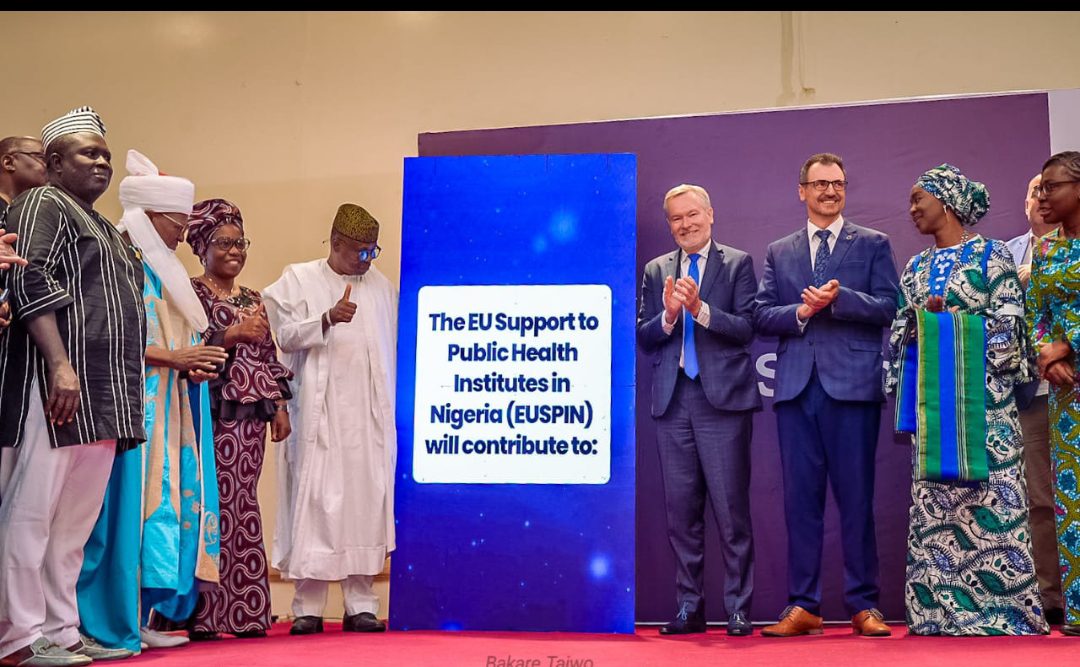
The Federal Government on Monday launched a major health sector initiative aimed at strengthening Nigeria’s public health institutions, disease surveillance systems, emergency preparedness and digital health infrastructure amid growing outbreaks of infectious and non-communicable diseases across the country.
Speaking at the official launch of the European Union–World Health Organization Support to Public Health Institutes in Nigeria (EU-SPIN) in Abuja, the Minister of State for Health and Social Welfare, Dr. Iziaq Adekunle Salako, said the project would reinforce Nigeria’s efforts to build a resilient and people-centred healthcare system capable of responding effectively to emerging health threats.
Salako described the initiative as a critical intervention aligned with President Bola Ahmed Tinubu’s Renewed Hope Agenda and the Nigeria Health Sector Renewal Investment Initiative (NHSRII).
According to him, strong public health institutions remain essential for disease prevention, early warning systems, outbreak response, and effective healthcare coordination across the country.
“This initiative designed to strengthen the national and sub-national public health institutions capacity to effectively coordinate and deliver essential public health functions is a welcome development as Nigeria journeys towards transforming its public health system, enhance preparedness, and improve the health and wellbeing of all citizens,” he said.
The minister noted that Nigeria’s public health infrastructure includes over 30,000 primary healthcare centres, 4,000 secondary health facilities and more than 200 tertiary health institutions owned by federal, state and local governments.
He stressed that despite the huge infrastructure, effective coordination and surveillance systems were necessary to ensure prompt response to outbreaks and other public health emergencies.
Salako said the Federal Government would continue to prioritise health security, emergency preparedness, digital health transformation, workforce development and sustainable financing under the ongoing reforms in the sector.
“The EUSPIN project directly contributes to several of these pillars, particularly in institutional strengthening, workforce development, digital health, and data systems,” he stated.
He expressed concern over Nigeria’s rising disease burden, citing persistent cases of malaria, tuberculosis, HIV and infectious disease outbreaks, alongside increasing cases of hypertension, diabetes, cancer and mental health conditions.
“These challenges are further compounded by maternal, newborn and child health indicators that remain unacceptably high in some parts of the country, as well as the growing health impacts of climate change, urbanisation, and population growth,” Salako added.
The minister called on stakeholders across all levels of government, development partners, academia and civil society organisations to ensure effective implementation and sustainability of the project.
Earlier in his opening remarks, the World Health Organization (WHO) Representative in Nigeria, Dr. Pavel Ursu, said the initiative came at a critical time as Nigeria continued to battle multiple public health threats.
According to him, Nigeria currently has four infectious disease outbreaks with Incident Management Systems activated, including Lassa fever, diphtheria, cholera and meningitis, while diseases such as dengue, measles, monkeypox and yellow fever remain under close surveillance.
Ursu also disclosed that although Nigeria had made progress in polio eradication, outbreaks of circulating vaccine-derived poliovirus continued to persist in parts of the North-East and North-West regions.
“Twenty-seven cVDPV2 cases have been reported out of which seven orphan viruses have been isolated in 2026,” he revealed.
He further stated that Nigeria attained a 57 per cent International Health Regulation States Parties Self-Assessment Annual Report score, surpassing the African regional average.
The WHO representative, however, expressed concern over poor immunisation coverage, citing the 2024 Demographic and Health Survey which showed that only 39 per cent of children aged 12 to 23 months were fully immunised with basic antigens, while 31 per cent had received no vaccination at all.
“Addressing these challenges sustainably requires strong, coordinated, and well-resourced Essential Public Health Functions embedded across health and allied sectors,” Ursu said.
He explained that the EU-SPIN project would strengthen public health governance, improve disease surveillance, support workforce development, deepen digital health systems and enhance coordination among institutions at national and sub-national levels.
According to him, the project also aligns with the International Health Regulations and the recently adopted Pandemic Accord of the World Health Assembly.
Also speaking at the event, Founder of the Wellbeing Foundation Africa, Mrs. Toyin Saraki, described the initiative as a significant step towards strengthening Nigeria’s public health architecture.
Saraki said public health outcomes depended largely on the strength of institutions responsible for delivering essential public health functions.
“Public health is built through institutions before it is delivered through services,” she said.
She noted that the EU-SPIN project focused on governance, workforce development, institutional strengthening and digital public health transformation, adding that the initiative would help bridge gaps in healthcare delivery, especially for vulnerable populations.
Saraki said civil society organisations would continue to play a key role in ensuring accountability, evidence-based programming and community engagement in the implementation of the initiative.
She reaffirmed the commitment of the Wellbeing Foundation Africa to support the success of the project through advocacy, technical expertise and community-based interventions.
The EU-SPIN project is expected to support stronger surveillance systems, improved laboratory networks, better emergency preparedness and enhanced use of data and digital technologies in Nigeria’s public health system.