


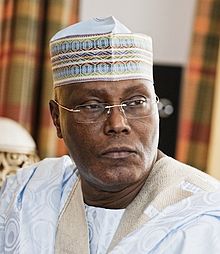
Former Vice President and African Democratic Congress (ADC) presidential candidate, Atiku Abubakar, has challenged the All Progressives Congress (APC) Presidential Campaign Council to produce evidence showing that an International Chamber of Commerce (ICC) tribunal found him guilty of corruption over the controversial Mambilla power project.
Atiku, through his Senior Special Assistant on Public Communication, Phrank Shaibu, accused the APC campaign council of distorting the outcome of the arbitration by presenting allegations considered during the proceedings as a corruption verdict against him.
The dispute followed the ICC arbitration involving Sunrise Power and Transmission Company Limited, its promoter Leno Adesanya and the Federal Government of Nigeria over the Mambilla Hydroelectric Power Project. The tribunal dismissed Sunrise’s claims and ordered the company and Adesanya to reimburse Nigeria for 75 per cent of its legal costs.
Atiku said the APC had failed to identify any portion of the final award in which the tribunal found that he received a $500,000 bribe, instructed former Power Minister Olu Agunloye to award the Mambilla contract to Sunrise Power, abused his office or participated in a corrupt conspiracy.
He said, “There is no such finding.”
According to Atiku, he was not a member of the technical committee that evaluated competing proposals for the project, did not sit on the procurement panel and did not award the contract.
He challenged the APC to produce documentary evidence of any instruction or intervention by him in the procurement process.
“I was not a member of the technical process that evaluated the competing proposals and recommended Sunrise. I did not sit on the procurement panel. I did not award the contract,” he said.
A major issue considered during the arbitration was a $500,000 payment made by Leno Adesanya through China Castle Investments Limited to Jennifer Douglas, Atiku’s then wife, in January 2003.
Atiku said the tribunal’s rejection of Adesanya’s explanation that the payment arose from a foreign-exchange transaction should not be interpreted as a finding that he received a bribe.
He argued that questioning the explanation for the payment was different from establishing that the money was a bribe paid to him or that he corruptly influenced the Mambilla contract.
Reports on the tribunal proceedings indicate that the payment and the explanation offered by Adesanya were examined by the arbitrators, who noted the absence of documentary or independent evidence supporting the explanation.
Atiku also rejected claims that he deliberately refused to appear before the tribunal.
He said he was not a party to the arbitration and did not testify before the tribunal, adding that the proceedings were between Sunrise Power, Adesanya and the Federal Government.
According to him, the participation of former Presidents Olusegun Obasanjo and Muhammadu Buhari, as well as former ministers Babatunde Fashola and Suleiman Adamu, in Nigeria’s defence did not establish that he himself had been summoned and refused to appear.
The former vice president accused the APC of turning allegations into established facts.
“An allegation is not a finding. Suspicion is not proof. The rejection of one man’s explanation is not the conviction of another man,” he said.
The APC Presidential Campaign Council had earlier called on Atiku to withdraw from the 2027 presidential race, citing issues arising from the Mambilla arbitration and the $500,000 payment. The council said the proceedings raised questions about Atiku’s role in the project.
Atiku, however, maintained that the controversy should be judged from the actual contents of the tribunal’s final award rather than political interpretations.
“These are not questions of political opinion. They are questions of record. They have factual answers,” he said.
He urged the APC to publish the specific portions of the award it relies upon and allow Nigerians to examine the findings themselves.
The controversy has added a fresh dimension to the political exchanges ahead of the 2027 presidential election, with the Mambilla project and the interpretation of the ICC award now featuring prominently in the exchanges between the APC and Atiku.