


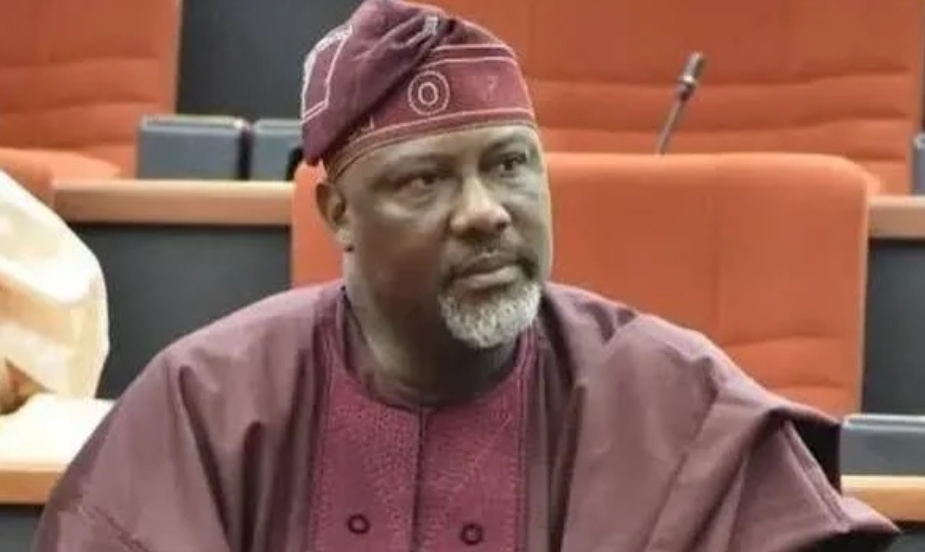
Former Kogi West senator, Dino Melaye, has accused the leadership of the 10th National Assembly of failing to adequately scrutinise President Bola Tinubu’s administration, warning that weak legislative oversight could undermine democratic accountability.
Melaye specifically criticised Senate President Godswill Akpabio and Speaker of the House of Representatives, Tajudeen Abbas, over the handling of electoral reforms, budget implementation, constitutional issues and other matters involving the executive arm of government.
The African Democratic Congress chieftain made the allegations on Wednesday in Abuja during a press conference where he assessed the performance of the current National Assembly and questioned its independence in checking presidential powers.
According to him, the legislature must go beyond passing bills and approving government proposals to ensure that executive decisions comply with the Constitution.
“A lifetime presidency does not begin with the abolition of term limits. It begins when the institutions created to restrain a President slack in duty,” Melaye said.
He added that although the President could make proposals, lawmakers had a constitutional responsibility to scrutinise, amend or reject them where necessary.
“As a former lawmaker, I cannot continue to fold my arms and watch as they continue to weaken the legislature for the executive,” he said.
Melaye argued that cooperation between the executive and legislature should not come at the expense of institutional independence.
“Cooperation is different from submission,” he stated.
Faults Police Act Amendment
The former senator cited the July 2024 amendment to the Nigeria Police Act, which allowed an Inspector-General of Police to remain in office until the expiration of the tenure specified in his appointment letter, notwithstanding the ordinary retirement provisions applicable to police officers.
He questioned the speed with which the amendment was passed, noting that the bill reportedly went through first, second and third readings in both chambers on the same day.
Melaye argued that the expedited passage raised concerns about the level of scrutiny given to legislation affecting the tenure of the nation’s police chief.
He noted that the amendment initially benefited former Inspector-General of Police, Kayode Egbetokun, who had served as Tinubu’s Chief Security Officer when the President was governor of Lagos State.
Egbetokun left office in February 2026 and was succeeded by Olatunji Disu, who had also served as Tinubu’s aide-de-camp during his tenure as Lagos governor.
Melaye, however, acknowledged that the appointments did not, in themselves, establish wrongdoing or electoral manipulation.
Questions Rivers Emergency Approval
The ADC chieftain also questioned the National Assembly’s handling of the declaration of a state of emergency in Rivers State in March 2025.
He raised concerns about whether the voting procedures adopted by both chambers satisfied the constitutional requirement for a two-thirds majority of all members.
According to him, extraordinary presidential powers must be subjected to the constitutional safeguards designed to prevent abuse.
Melaye further criticised the House of Representatives over its handling of the controversy surrounding the Electoral Act 2026, particularly the reversal of its earlier decision on mandatory real-time electronic transmission of election results.
The House had adopted the provision in December 2025 before lawmakers reconsidered their position in February 2026, a development that reportedly triggered protests and disorder in the chamber before an executive session was held.
Questioning the proceedings, Melaye asked, “What becomes of parliamentary representation when members say ‘nay’ and the presiding officer declares ‘aye’ to please the President?”
He maintained that parliamentary procedures must reflect the decisions of elected representatives rather than weaken the legislature’s ability to hold the executive accountable.
Raises Questions Over N26.22tn Spending
Melaye also faulted what he described as inadequate legislative oversight of budget implementation and public expenditure.
He cited allocations to Service-Wide Votes of approximately ₦4.08 trillion in 2024, ₦9.31 trillion in 2025 and ₦12.83 trillion in 2026, bringing the combined figure to about ₦26.22 trillion over the three years.
He said the allocations raised questions about the extent of legislative scrutiny of government spending and the transparency of fund releases.
The former lawmaker acknowledged that the Budget Office had explained that the 2026 allocation covered identifiable government obligations, including personnel costs, recurrent expenditure and capital projects.
However, he insisted that such explanations did not absolve lawmakers of their responsibility to monitor public funds and ensure that appropriated money was spent for its intended purposes.
Efforts to obtain a reaction from the Clerk of the National Assembly, Kamoru Ogunlana, were unsuccessful as of the time of filing the report.
Ogunlana neither answered calls nor responded to a text message seeking clarification on the allegations.