


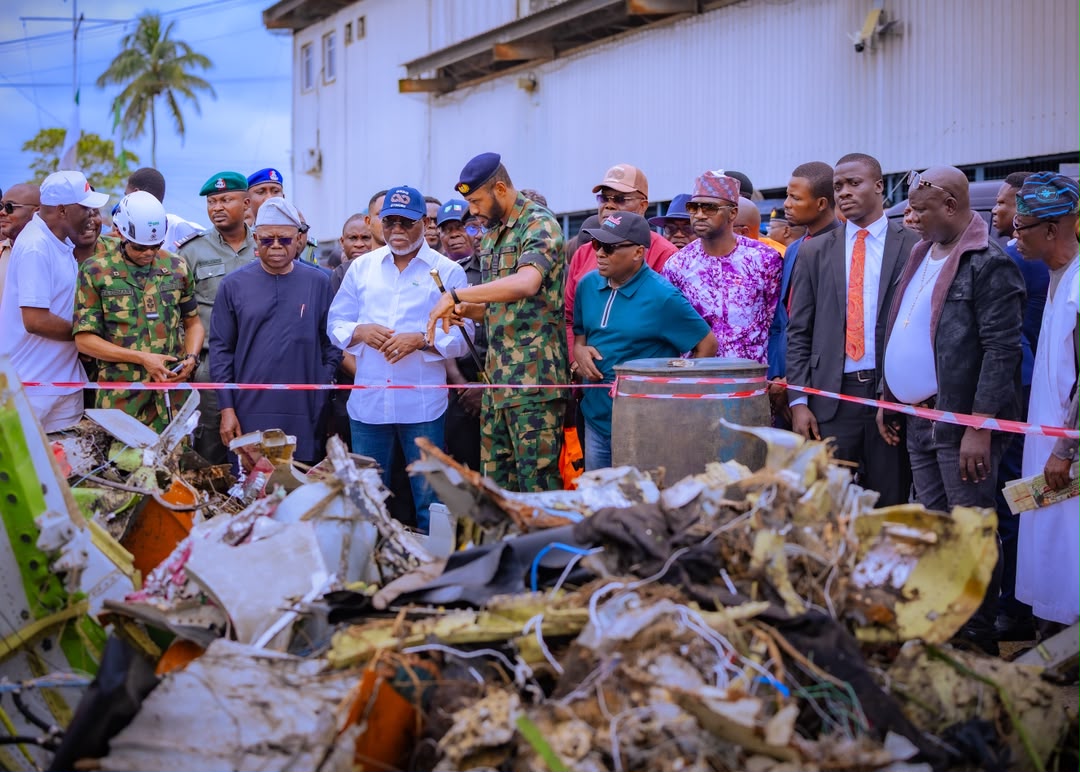
Ondo State Governor, Lucky Aiyedatiwa, has said the pilot of the Nigerian Air Force (NAF) ATR-42 aircraft that crashed in Igbokoda, Ilaje Local Government Area, may have averted a bigger disaster by steering the aircraft away from a residential area before it went down in a swamp.
Aiyedatiwa stated this on Wednesday when he visited the crash site, located about 200 metres from the residential area of the community.
The governor described the incident as a national tragedy, saying no survivor had been found at the scene as of the time of his visit.
He said the aircraft had approximately 25 people on board, adding that the exact cause of the crash could only be established through proper investigation.
According to him, residents who witnessed the incident said the aircraft appeared to be descending towards the community with a sound suggesting an engine problem before the pilot manoeuvred it away from the residential area.
“The aircraft was almost landing within the community, but the pilot managed to manoeuvre it away before it landed about 200 metres away and went straight into the swamp,” he said.
‘Very gory sight’
Aiyedatiwa described the crash site as a “very gory sight”, with parts of human bodies, clothes, jackets belonging to personnel on board and fragments of the aircraft scattered around the area.
He said the main body of the aircraft had yet to be located, as it was believed to have become submerged in the swamp.
Some recovered aircraft components were shown to the governor and preserved for further investigation.
Aiyedatiwa visited the scene alongside personnel of the Nigerian Navy and Air Force, divers, the National Emergency Management Agency (NEMA) Southwest Director, the State Emergency Management Agency director and residents who had been involved in rescue efforts since Monday.
Swamp makes rescue difficult
The governor disclosed that he directed the state Ministry of Works to deploy two amphibious machines, popularly known as swamp buggies, to improve access through the waterways.
He said the machines had cleared portions of the bush, enabling rescue teams to move larger boats closer to the crash site.
According to him, the improved access had also allowed teams to excavate parts of the soil in search of the wreckage and the main body of the aircraft.
Navy personnel and local divers were continuing the search in deeper sections of the swamp for possible bodies and the cockpit.
Aiyedatiwa said the nature and depth of the swamp could have caused the aircraft to sink deeply into the mud.
“From construction experience and analysis of this area, for you to get to refusal level, it’ll get to about 30 metres deep,” he said.
Jet fuel pollutes swamp
The governor also disclosed that aviation fuel was leaking into the water, resulting in pollution around the crash site.
He expressed gratitude that the aircraft did not come down directly in the community, saying such an occurrence could have resulted in a far greater catastrophe.
Aiyedatiwa commiserated with President Bola Ahmed Tinubu over the death of the military personnel and sympathised with their families and the Nigerian Air Force.
He described the deceased as young and capable Nigerians who had volunteered to defend the country’s territorial integrity.
The governor urged Nigerians to continue praying for the bereaved families, saying the loss was devastating and unexpected.
However, based on the condition of the crash site, he expressed doubt that any of the occupants could have survived.
Briefing the governor on the search and rescue operation, the Commander, Nigerian Navy Forward Operating Base, Igbokoda, Captain Andy Alemongwa, displayed some of the aircraft parts recovered from the crash site.