


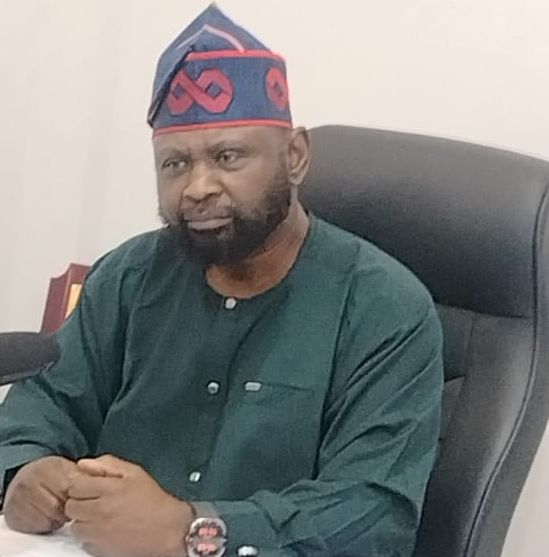
A senatorial aspirant in Kogi Central, Chief Momoh Y. Obaro, has warned that the All Progressives Congress (APC) risks losing the 2027 general elections if it fails to reconcile aggrieved members and address grievances arising from its primary elections.
Obaro, the APC Secretary in the United Kingdom, urged the party’s national and state leadership to go beyond setting up reconciliation committees and ensure that aspirants who purchased nomination forms but lost out in the primaries are adequately carried along.
Speaking in an interview on the party’s preparations for the 2027 elections and other national issues, he said unresolved internal disputes could discourage loyal members and lead to voter apathy.
Obaro, who is challenging the outcome of the process that produced the APC candidate for Kogi Central Senatorial District in court, said he remained committed to the party despite the controversy.
He disclosed that his supporters across the 57 wards in the senatorial district were already mobilising for the APC, adding that the party’s success was also important to his ongoing legal battle.
He said aspirants who invested their resources and energy in building the party should not be abandoned simply because they failed to secure tickets.
“Those people should be assembled, whether at the regional or state level, to ensure that they continue working together. A position is only one, and only one person will take it. But those who have contributed to building the party should not be completely ignored,” he said.
The APC chieftain disclosed that he had met with the reconciliation committee constituted by Kogi State Governor, Ahmed Usman Ododo, but expressed concern that several grievances remained unresolved.
He, however, pledged to support whoever eventually emerges as the party’s candidate if his legal challenge does not succeed.
On President Bola Tinubu’s administration, Obaro defended the removal of fuel subsidy and harmonisation of the foreign exchange market, describing them as difficult but necessary measures to address longstanding structural problems in the economy.
He argued that although the reforms had increased revenue available to the Federal Government and improved allocations to states and local governments, their benefits had yet to translate into better living conditions for many Nigerians.
According to him, state governments must take greater responsibility for translating increased federal allocations into jobs, agricultural development and improved household incomes.
Using Kogi State as an example, he said the state had enormous economic opportunities in agriculture, mining, fisheries and livestock production that remained largely untapped.
He estimated that proper identification and utilisation of available arable land could create between 10,000 and 20,000 jobs in the agricultural sector alone.
Obaro maintained that state governments should move beyond celebrating monthly federal allocations and salary payments by investing in productive sectors capable of generating sustainable wealth.
He also urged Nigerians to scrutinise the economic alternatives being proposed by politicians, particularly calls by opposition figures to reverse fuel subsidy removal.
He said politicians advocating a return to the previous subsidy regime must explain how they intend to address the resulting revenue shortfall and fund government obligations.
“Nigerians need to educate themselves on these issues. Let people look at the country’s revenue, what the states are receiving and what any politician proposing to reverse subsidy intends to do about the resulting revenue shortfall,” he said.
The Kogi Central aspirant further challenged the National Assembly to develop practical economic intervention programmes for their constituencies rather than leaving the responsibility of addressing economic hardship entirely to the President.
He proposed a constituency-based economic Marshall Plan that would identify employment opportunities, support vulnerable groups and provide targeted assistance to young people.
Obaro also blamed Nigeria’s overdependence on crude oil for its economic difficulties, arguing that the neglect of agriculture and manufacturing had weakened the country’s productive capacity.
On whether Kogi Central had benefited from producing the state’s governor for more than a decade, he said the expectations of residents had not been met.
He argued that occupying the governorship position or having political leaders from a particular ethnic or geographical background should not automatically translate into improved living conditions.
Citing multidimensional poverty figures he attributed to the National Bureau of Statistics, Obaro claimed that about 50 per cent of residents in Kogi Central remained multidimensionally poor.
He identified inadequate healthcare, electricity, housing and other essential services as major challenges confronting the people.
The APC chieftain said governance should be measured by its impact on citizens rather than the ethnic identity or geographical origin of those holding public offices.
“Having somebody close to me as my brother or someone who speaks my language is not necessarily solving our problems. We have to begin to look for people who are capable and can solve problems,” he said.
He urged voters to prioritise competence, accountability and measurable development plans over ethnic sentiments, political loyalty and election-period handouts.
Obaro concluded that addressing Nigeria’s economic and social challenges required collective responsibility from all tiers of government, stressing that the President alone could not deliver the desired transformation without effective support from state and local governments.

