


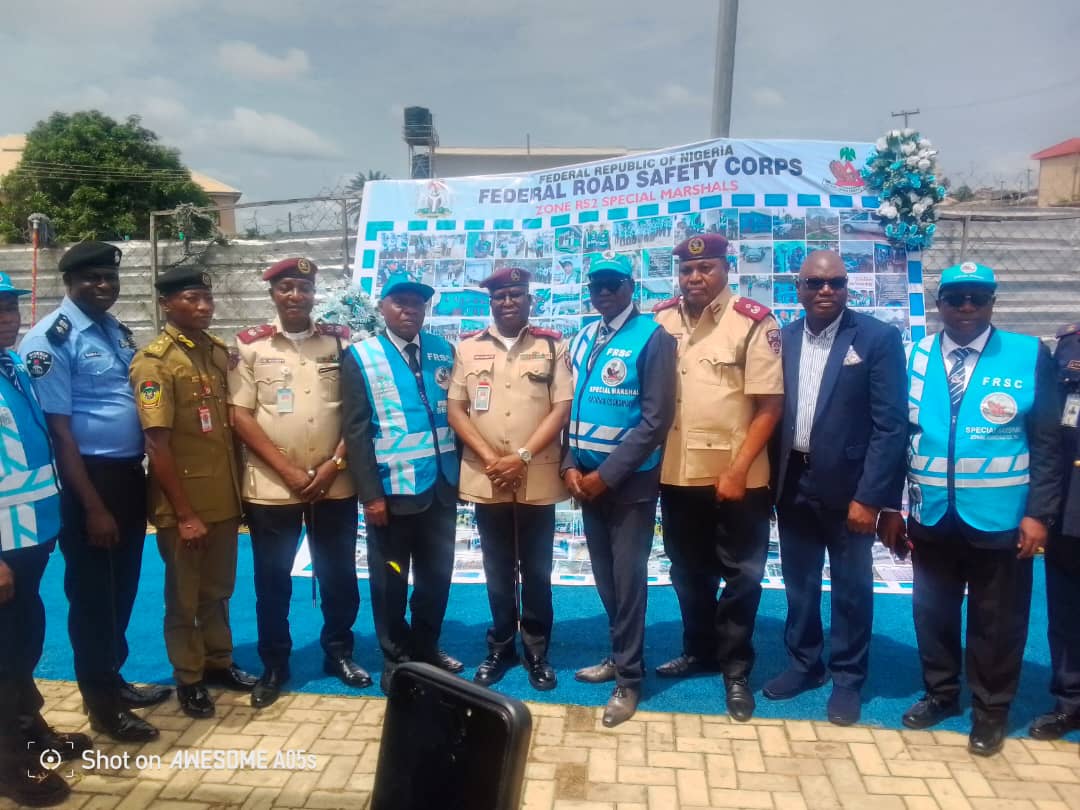
The Federal Road Safety Corps (FRSC) has called for stronger partnerships, improved data collection and the deployment of technology, including artificial intelligence (AI), to prevent road crashes and improve safety across Nigeria.
The Corps said the growing challenges of urbanisation, increasing vehicle ownership and changing road-user behaviour required a more coordinated, evidence-based approach to road safety.
The call was made on Thursday at the 2026 Special Marshals Zonal Conference for Zone RS2, covering Lagos and Ogun states, held at the Muhammadu Buhari International Conference Centre, Federal Medical Centre, Abeokuta.
The conference had the theme: “Repositioning Special Marshals for Greater Impact through Strategic Partnerships and Data-Driven Road Safety Interventions.”
Representing Ogun State Governor Dapo Abiodun, the Commissioner for Transportation, Engr. Gbenga Dairo, reaffirmed the state government’s commitment to supporting the FRSC in promoting safer roads.
Dairo commended the Special Marshals for their voluntary service, describing their contribution as vital to the Corps’ efforts to reduce road crashes and improve traffic management.
In a message delivered on behalf of the Corps Marshal, Shehu Mohammed, by Assistant Corps Marshal Matthew Olonisaye, the FRSC urged Special Marshals to embrace innovation, technology and evidence-based decision-making in carrying out their duties.
The Corps Marshal stressed that road safety could no longer be left to the FRSC alone, calling for stronger collaboration with government institutions, transport operators, educational institutions, faith-based organisations, community leaders, private organisations and development partners.
He also urged members to improve documentation, support research and strengthen data collection and performance evaluation to ensure that road safety interventions were properly targeted and effective.
Addressing participants through Lagos State Sector Commander, Corps Commander Kehinde Hamzat, Olonisaye described Lagos and Ogun as strategic economic hubs with some of the country’s busiest highways, making coordinated action essential to protecting lives.
He challenged Special Marshals to move beyond routine volunteer activities by deploying their professional expertise and networks to improve public enlightenment, intelligence gathering and crash prevention.
He also emphasised the need for integrity and professionalism in carrying out their responsibilities.
Special Marshals report 80% progress
The National Coordinator of Special Marshals, Dr. Adaji Usman, whose address was presented by former National Coordinator, Dr. Sini Kwabe, disclosed that the organisation had implemented more than 80 per cent of its 15-point agenda within the past year.
He listed improvements in discipline, standardised enlistment, training, operational data management, welfare initiatives, financial transparency and communication among the achievements recorded.
However, he called for greater compliance with directives and stronger collaboration across commands to consolidate the progress.
Delivering the conference paper, former FRSC Sector Commander and former Chief Executive of TRACE, Ayo Sangofadeji, advocated a Safe System approach, arguing that road crashes could largely be prevented through coordinated action by government, enforcement agencies, transport operators, communities and road users.
Sangofadeji recommended digital reporting platforms, artificial intelligence and predictive crash analysis to strengthen road safety intelligence and enable authorities to identify high-risk areas and develop targeted interventions.
He also called for stronger partnerships with government agencies, transport unions, insurance companies, technology firms and community institutions.
According to him, effective collaboration among stakeholders would improve the identification of road safety risks and support more proactive measures to prevent crashes.
Earlier, the Zonal Coordinator of Zone RS2 Special Marshals, Pastor Olusegun Akintan, urged members to embrace data-driven operations, describing accurate information as critical to saving lives.
Akintan commended Zone RS2 for scoring 96 per cent in a recent national assessment, urging participants to translate the conference’s recommendations into practical actions.
He said the ultimate goal should be measurable improvements in road safety across Lagos and Ogun states.


