


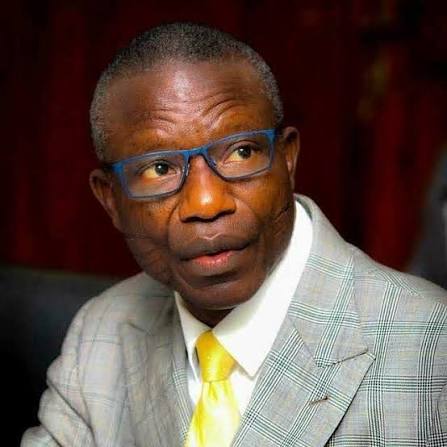
AKURE — The National President of the Pentecostal Fellowship of Nigeria, PFN, Bishop Wale Oke, has warned that the credibility of Nigeria’s democracy ahead of the 2027 general elections will depend largely on the ability of the Independent National Electoral Commission, INEC, to remain impartial.
Oke, who spoke with journalists at the 38th annual convention of Agape Christian Ministries in Akure, Ondo State, also called on the Federal Government to take decisive action against religious extremists using violence to pursue their agenda.
The PFN president said INEC must operate independently of political parties and resist any attempt to influence its conduct of the 2027 elections.
«“INEC is a government functionary. It is not part of any political party. INEC is to regulate all political parties and to conduct elections, not to take sides with any,” he said.»
He added: “We are demanding that for the exercise of our civil rights, INEC does not partake in partisan politics. The integrity of Nigeria’s democracy hangs in the balance.”
Oke also urged political parties and candidates to avoid using ethnicity and religion as tools for securing political support, saying competence and fairness should take precedence in the choice of leaders.
“Politicians should not play the ethnic card in choosing who leads us. They should not play the religious card,” he said.
The cleric advocated religious balance in political leadership, arguing that Nigeria’s secular character makes inclusiveness important in the composition of government.
“Because Nigeria is a secular state, there is no need for it to be altogether Muslim or altogether Christian. Don’t favour a religion against another. Be neutral. Nigeria must recover equitably,” he said.
Oke seeks tougher action against extremists
On insecurity, the PFN president condemned the use of religion to justify killings, kidnappings and attacks on communities, urging security agencies to deal decisively with perpetrators regardless of their religious affiliation.
“There are radicals who are bent on turning Nigeria into a caliphate state. But the Constitution guarantees freedom of religion and freedom of worship,” Oke said.
He described kidnapping, attacks on schools and killings as criminal acts, regardless of the motive or religious justification offered by perpetrators.
“Kidnapping is criminal. Taking children from school is criminal. Beheading is criminal. If anybody is doing that in the name of religion, he is a criminal, whether he is from the Christian side or from the Islamic side,” he said.
Oke, however, cautioned against portraying the actions of extremists as representative of the wider Muslim community, urging Muslim leaders to assist security agencies in identifying and reporting radical elements.
“It is not the generality of Islam. It is the radicals among them. The Muslim community should identify those radicals and hand them over to law enforcement agencies,” he said.
The PFN president stressed that religious persuasion should be peaceful and voluntary, insisting that violence cannot be justified in the name of faith.
“If you can persuade me to change from being a bishop into becoming a Muslim, and you succeed, God bless you. If I persuade you to convert to Christianity, God bless me. Let it be by persuasion,” he said.
“But if it is by violence, no. There is a difference between criminality and religion. The government must not tolerate criminality.”
Call for equitable governance
Oke also urged Nigerians to seek solutions to the country’s economic and security challenges while calling for greater fairness in governance.
He identified insecurity and economic hardship among the major challenges confronting Nigerians and encouraged citizens to continue seeking divine intervention while supporting efforts to address the problems.
The cleric also clarified his earlier comments on church titles, explaining that titles such as “Senior Pastor” and “Archbishop” may serve administrative purposes as churches expand.
He distinguished between practices not expressly mentioned in the Bible and practices that are inherently unbiblical, arguing that organisational structures can evolve to accommodate the growth of religious institutions.