



Nigeria and Japan are exploring plans to establish a joint industrial and investment hub to attract businesses, accelerate technology transfer and expand industrial development as both countries seek stronger economic ties after 66 years of diplomatic relations.
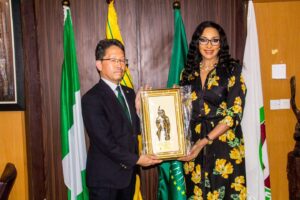
The proposal was discussed on Monday, October 26, 2026, when Nigeria’s Minister of Foreign Affairs, Ambassador Bianca Odumegwu-Ojukwu, met Japan’s Ambassador to Nigeria, Suzuki Hideo, to explore ways to translate existing bilateral agreements into measurable economic gains.
In a statement issued on Tuesday, October 27, the minister called for the implementation of agreements reached at the 10th Nigeria–Japan Special Partnership Forum, held in Abuja on August 27, 2026, through concrete programmes, investment commitments and regular consultations between both countries.
“The outcomes of the Forum must be translated into concrete programmes, investment commitments and measurable development outcomes,” Odumegwu-Ojukwu said.

She asked the Japanese Embassy to support the development of a practical roadmap for the proposed Nigeria–Japan Industrial and Investment Hub, which would facilitate business partnerships, technology transfer and access to the wider African market.
Nigeria seeks Japanese investment in manufacturing
The minister urged Nigerian and Japanese companies to pursue joint ventures, develop local content, transfer technical skills and integrate Nigerian businesses into Japanese supply chains.
She also encouraged greater involvement by the Japan External Trade Organization (JETRO) to connect Japanese investors with credible Nigerian businesses and public-sector partners.
The proposed hub is intended to provide a framework for expanding commercial relationships and encouraging industrial investment, although the statement did not specify a launch date, funding commitment or proposed location.
Nigeria is seeking to use its economic and regional position to attract Japanese businesses interested in manufacturing, technology and access to African markets.
For Japanese investors, deeper cooperation could open opportunities in local production, infrastructure, energy and supply-chain development, while Nigerian businesses could benefit from technical expertise and stronger international commercial links.
Energy and critical minerals among investment priorities
Odumegwu-Ojukwu said Nigeria welcomed Japan’s interest in resilient energy and critical-mineral supply chains, identifying solid minerals, gas development, cleaner energy technologies and industrial decarbonisation as potential areas for cooperation.
The discussions come as countries seek more resilient supply chains for energy resources and minerals used in industrial production and emerging technologies.
Stronger Nigeria–Japan cooperation in these areas could create opportunities for investment in resource development, processing and related infrastructure.
However, the statement did not announce specific Japanese investments or financial commitments in these sectors.
Japan-backed $10m initiative targets Nigerian startups
The minister also acknowledged Japan’s development assistance through the Japan International Cooperation Agency (JICA), highlighting cooperation in infrastructure, healthcare, agriculture, education and technical training.

She welcomed a JICA-supported $10 million initiative designed to strengthen Nigeria’s startup ecosystem through catalytic capital and institutional development, in partnership with the Nigeria Sovereign Investment Authority.
The initiative is intended to support the development of Nigeria’s startup environment, although the statement did not provide details on its disbursement schedule, beneficiaries or specific funding arrangements.
Odumegwu-Ojukwu said closer economic cooperation should deliver practical outcomes for businesses and citizens rather than remain limited to diplomatic agreements.
Nigeria seeks easier business and student travel
The foreign affairs minister also called for continued dialogue on visa-related challenges affecting travel between the two countries.
She said practical measures were needed to facilitate legitimate travel for businesspeople, students, researchers, government officials and tourists.
Responding, Ambassador Suzuki said Japan was interested in deepening cooperation with Nigeria, which he described as a strategic African giant.
He also assured the Nigerian government that visa-related issues would be handled expeditiously.
Improved travel arrangements could support business exchanges, academic collaboration, tourism and direct engagement between Nigerian and Japanese institutions.
Both countries reaffirm regional security cooperation
The meeting also addressed regional security and development, with Nigeria acknowledging Japan’s contributions to peacebuilding, humanitarian assistance and stabilisation efforts in Nigeria and West Africa.
Odumegwu-Ojukwu reaffirmed Nigeria’s commitment to regional stability through the African Union and the Economic Community of West African States (ECOWAS), while encouraging continued Japanese support for African-led peace and development initiatives.
She said the existing relationship offered scope for a more dynamic partnership focused on investment, industrialisation, technology transfer and shared prosperity.
The discussions mark another effort by both countries to build on more than six decades of diplomatic relations. The next measure of progress will be whether the proposed industrial hub and other initiatives translate into concrete investments, stronger business links and measurable economic benefits.