


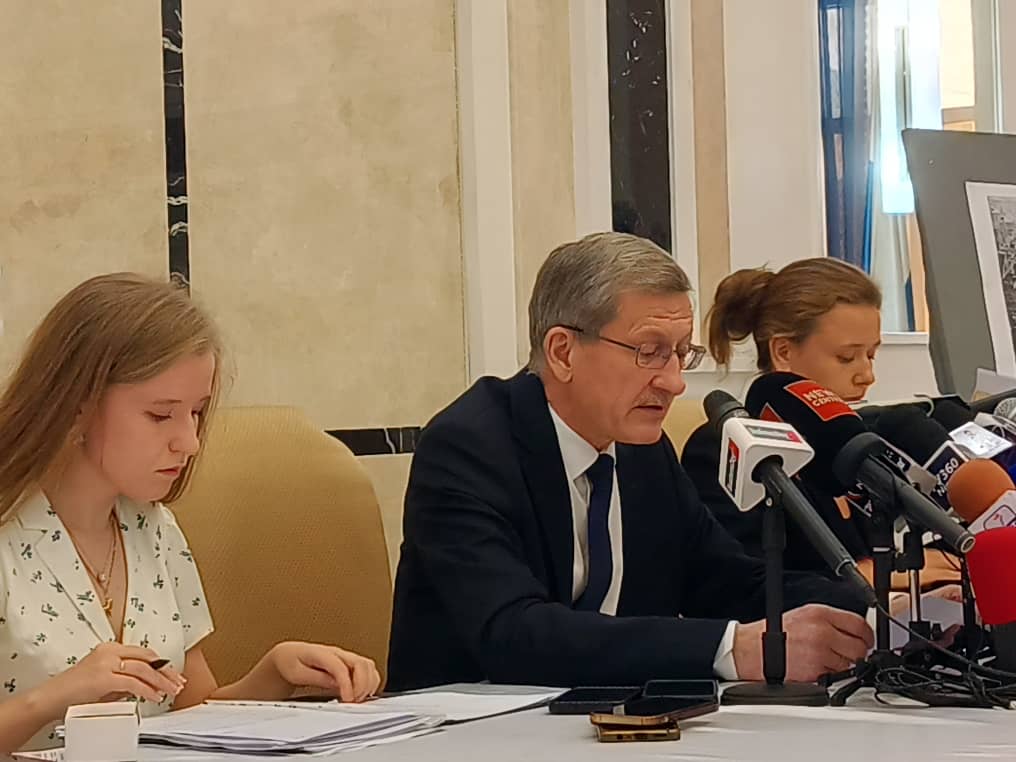
ABUJA – The Russian Federation’s Ambassador to Nigeria, Mr. Andrey Podelyshev, has emphasized the global significance of Victory Day while warning against what he called growing attempts to distort historical facts about World War II.
Speaking at a press conference in Abuja on Tuesday ahead of the May 9 commemoration of the 81st anniversary of the end of the war in Europe, the envoy described the date as both a deeply personal moment for Russians and a cornerstone of the modern international order.
According to Ambassador Podelyshev, the victory over Nazi Germany not only ended one of the deadliest conflicts in human history but also laid the foundation for contemporary international law and institutions, including the United Nations. He noted that Victory Day remains a symbol of sacrifice, with nearly every Russian family connected to the war through the stories of soldiers, civilians, and victims of Nazi atrocities.
“Victory Day is not only a day of remembrance but also a day of responsibility for preserving the truth about those events, for preventing its distortion, and for passing historical truth on to future generations,” the ambassador said. “Today, it carries even greater weight as we witness systematic attempts to rewrite history.”
He stressed that preserving this memory is essential for maintaining historical truth and ensuring global stability.
Concerns Over ‘Battle of Narratives’
Podelyshev raised concerns over what he called a “battle of narratives” surrounding World War II history, alleging that some countries are attempting to reinterpret the war by equating the Soviet Union with Nazi Germany—a move he described as misleading and harmful to the established historical record.
“The most dangerous trend is the persistent desire of the West to put an equal sign between the aggressor and the liberator,” he said. “At the official level, a number of countries are promoting rhetoric in which the Soviet Union—which lost millions of lives to save the world—is accused of starting the war on a par with Hitler’s Germany.”
He also criticized the removal of Soviet war memorials in parts of Europe, particularly in Poland and the Baltic states, calling such actions a deliberate effort to erase the role of Soviet forces in defeating Nazism. At the same time, he expressed concern over the recognition of individuals and groups he described as Nazi collaborators in certain countries.
“We cannot remain silent when annual marches in honour of Nazi unit legionnaires are held in the Baltic states, and when in Ukraine the cult of Stepan Bandera and Roman Shukhevych has been elevated to the level of state ideology,” the ambassador maintained. “Let us call things by their names.”
On Ukraine, Podelyshev accused authorities of promoting figures linked to wartime nationalist movements and condemned what he described as the ongoing glorification of such actors. He further alleged that extremist groups continue to operate within the country—claims that remain widely disputed internationally.
Legal Push for Historical Recognition
Addressing legal developments, the envoy highlighted recent Russian legislation recognizing Nazi crimes on Soviet territory as genocide. He said the laws aim to protect historical truth, criminalize the justification of Nazism, and preserve the memory of victims. He added that Russia has also established April 19 as a national day of remembrance for victims of genocide during the war.
The ambassador underscored that more than 27 million Soviet citizens died during World War II, describing the scale of loss as “unprecedented.” He argued that the systematic nature of Nazi policies in occupied territories meets the criteria for genocide under international law, citing mass killings, forced labour, and widespread destruction of civilian life. He called for broader international recognition of these events as genocide, stating that such acknowledgment is necessary to restore historical justice and honour the victims.
In his concluding remarks, Podelyshev referenced a recent United Nations General Assembly resolution against the glorification of Nazism and expressed appreciation to Nigeria for its support. He reiterated that safeguarding historical truth is vital to preventing the resurgence of extremist ideologies and maintaining global peace.
Victory Day, he said, should serve not only as a moment of remembrance but also as a reminder of the responsibility to uphold historical accuracy in shaping the future of international relations.