


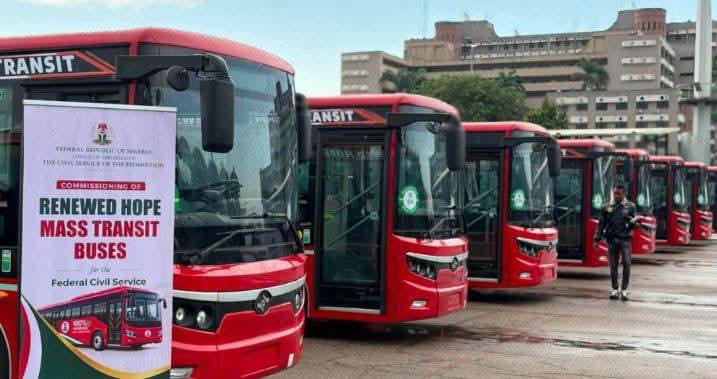
The Federal Government has commissioned 100 electric buses for Federal Civil Servants nationwide, in a major transportation intervention aimed at reducing commuting costs, improving workers’ welfare and boosting productivity in the public service.
The buses were commissioned in Abuja on Wednesday by the Office of the Head of the Civil Service of the Federation (OHCSF), with the first batch of 37 locally assembled electric buses handed over for deployment. The remaining 63 buses are expected to be deployed in phases.
The Head of the Civil Service of the Federation, Mrs Didi Walson-Jack, described the initiative as her “parting gift” to the public service as her tenure ends within 24 hours.
She said the programme represented a practical demonstration of President Bola Ahmed Tinubu’s Renewed Hope Agenda, noting that transportation challenges had significant effects on the finances, safety, punctuality and productivity of civil servants.
“To God be all the glory. I could not have asked for a more fitting note on which to close this chapter of service than receiving and handing over the keys to something that will keep moving, keep working, long after I have gone home,” Walson-Jack said.
She added: “An intervention that makes transportation safer, more reliable, and more affordable is therefore not a peripheral welfare gesture. It is an investment in a more productive Civil Service.”
According to her, the acquisition of the buses was funded through the Renewed Hope Infrastructure Development Fund.
Speaking at the ceremony, the Minister of State for Industry, Trade and Investment, Senator John Owan Enoh, said the initiative went beyond transportation, describing it as an intervention aimed at improving welfare while supporting local industrial development.
“What we are launching today is more than buses. It is about welfare. It is about productivity. It is about industrialisation. It is about translating the Renewed Hope Agenda into tangible benefits that Nigerians can see and experience,” Enoh said.
The minister said the government was pursuing a dual-fuel future involving compressed natural gas and electric vehicles as part of its strategy for transforming Nigeria’s automotive industry.
He said Nigeria’s large population provided enormous opportunities for local vehicle manufacturing and job creation.
“A country of more than 200 million people cannot continue to export the economic opportunities created by its domestic demand. The vehicles that move Nigerians represent an enormous industrial opportunity,” he said.
Enoh disclosed that the Ministry, through the National Automotive Design and Development Council, was working to ensure that vehicles and mobility solutions were produced locally.
“When we support a credible Nigerian manufacturer, we are not simply buying a vehicle. We are supporting factories, creating jobs, developing engineers and technicians, and keeping more economic value within Nigeria,” he said.
He urged manufacturers to invest in factories, deepen local content and develop Nigerian technical manpower, stressing that Nigeria must not be left behind in the global transition to electric vehicles.
“Our manufacturers must progressively manufacture electric vehicles locally. Our engineers must understand battery technology, power electronics and software. Our universities must produce the skills this industry requires,” Enoh said.
Giving the technical specifications, the Director-General of NADDC, Oluwemimo Osanipin, said each electric bus could accommodate up to 100 passengers and travel a minimum of 200 kilometres on a full charge.
He added that the buses would have maintenance costs about 40 per cent lower than vehicles powered by petrol and diesel.
Osanipin said the buses produced zero tailpipe emissions and were 100 per cent made in Nigeria, in line with the Federal Government’s Nigeria First policy.
Responding on behalf of Federal Civil Servants, the Chairman of the Joint National Negotiating Council, Comrade Daniel Danjuma, thanked the OHCSF and the Federal Government for the initiative.
“Mobility is one of the key enablers of national development. We thank you for providing these buses for us. We also pray that adequate arrangements have been made to maintain them accordingly,” he said.
The OHCSF said it had developed a sustainability framework for the buses, covering transparent and equitable route allocation, regular maintenance, qualified drivers, passenger safety, cleanliness and effective monitoring.
The government said the initiative was expected to provide Federal Civil Servants with safer and more affordable transportation while supporting local manufacturing and Nigeria’s transition towards cleaner energy.