



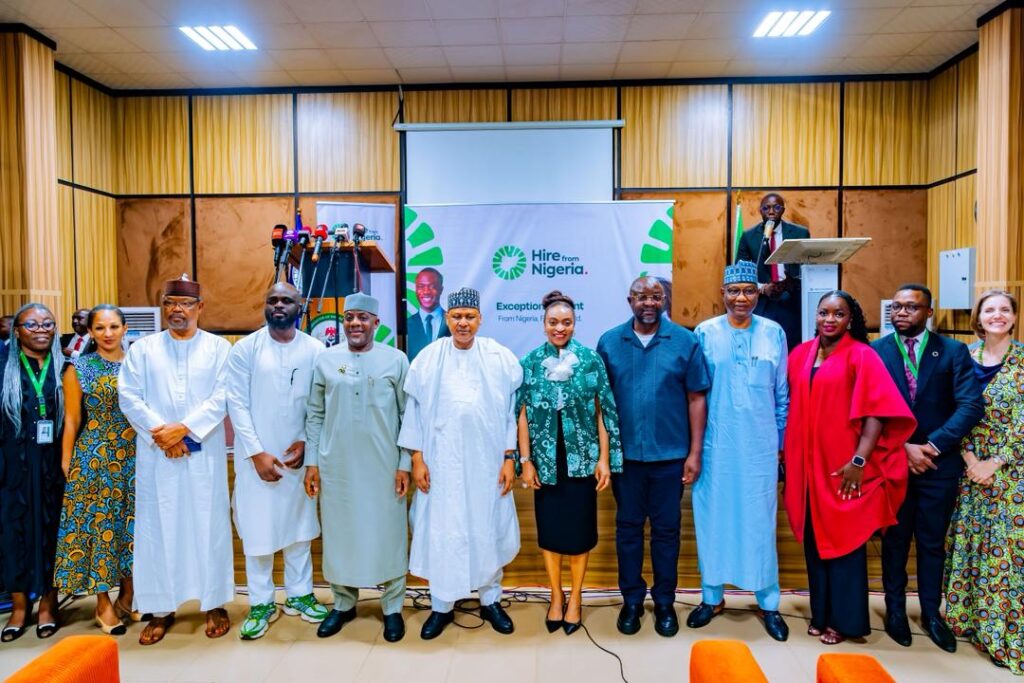
The Federal Government has launched the “Hire from Nigeria” campaign as part of efforts to position Nigerian talent as a global source of skilled professionals and digitally delivered services, with a target of creating one million export-linked jobs by 2030.
The initiative brings together the Federal Ministry of Industry, Trade and Investment (FMITI), the Federal Ministry of Information and National Orientation, the Federal Ministry of Education, the National Talent Export Programme (NATEP), the Bank of Industry’s iDICE Programme, Tech4Dev, the Mastercard Foundation and other private-sector and development partners.
The details were contained in a statement issued by Obilor-Duru Augustina Okechi, Head of Information and Public Relations, Federal Ministry of Industry, Trade and Investment, following the launch of the campaign at Radio House, Abuja.
Speaking at the event, the Minister of Industry, Trade and Investment, Dr. Jumoke Oduwole, described the initiative as a strategic shift towards connecting Nigeria’s growing pool of skilled professionals directly with international demand.
“The ‘Hire from Nigeria’ campaign is more than a communications initiative. It is a national economic proposition designed to make Nigerian talent and service providers easier for international employers and businesses to discover, trust and hire,” Oduwole stated.

The minister identified Nigeria’s large youthful population, English-language proficiency, expanding technology ecosystem and growing capabilities in technology, creative services, business support and other digitally delivered services as key advantages in the global talent market.
According to her, the National Talent Export Programme, launched by President Bola Ahmed Tinubu in 2023, is building the systems needed to convert Nigeria’s demographic strength into sustainable employment, export earnings and investment.
NATEP is pursuing the one-million-job target through initiatives including the National Coordination Mechanism for Services Exports, the Nigeria Talent Accelerator Network and the development of Nigeria’s first National Outsourcing Policy, which is scheduled for launch in November 2026.
The campaign is also expected to receive international exposure during the 81st United Nations General Assembly in New York, where Nigerian talent providers and service companies are expected to engage global employers, outsourcing buyers, investors and strategic partners.
Government targets global demand for Nigerian skills
Minister of Information and National Orientation, Mohammed Idris, described the campaign as an opportunity to place Nigeria’s human capital at the centre of the country’s economic engagement with the global economy.
The ministry, he added, would deploy its communication platforms, agencies and strategic partnerships to promote Nigerian talent to domestic and international audiences.
“With the right skills, infrastructure, professional standards and access to markets, Nigerians can work from home and provide services to clients and businesses anywhere in the world,” Idris stated.
He linked the initiative to the Renewed Hope Agenda, particularly the government’s focus on job creation, economic diversification, skills development and youth empowerment.
The Minister of Education, Dr. Maruf Tunji Alausa, meanwhile, highlighted investments in technical and vocational education, digital skills and emerging technologies as part of efforts to prepare Nigerians for the changing global labour market.

Alausa disclosed that more than 200,000 Nigerians are currently undergoing training through technical and vocational education programmes, while plans are underway to establish a Digital Technology Academy expected to train more than 35,000 Nigerians in critical technology fields.
The areas identified for capacity development include artificial intelligence, cybersecurity, cloud computing and software development.
Nigeria seeks bigger share of global services market
The Senior Special Assistant on Strategy and Communications to the Minister of Industry, Trade and Investment, Mrs. Olajumoke Dan-Okayi, described the campaign as the market-facing expression of NATEP’s broader efforts to connect Nigerian skills and service providers with domestic and international demand.
She noted that NATEP was launched on the margins of the 78th United Nations General Assembly in 2023 to position Nigeria as a global hub for talent sourcing, talent export and services exports.
The forthcoming National Outsourcing Policy, according to Dan-Okayi, is expected to strengthen industry standards, improve competitiveness, build employer and investor confidence and support sustainable growth in Nigeria’s outsourcing sector.
“The ‘Hire from Nigeria’ campaign is not a standalone communications initiative,” she stated. “It is the market-facing expression of NATEP’s broader work to create stronger pathways between Nigerian talent and service providers and opportunities in global markets.”
The Founder and President of Tech4Dev, Mr. Joel Ogunshola, described the campaign as an opportunity to reshape international perceptions of Nigerian professionals and connect the country’s workforce more deliberately with global demand.
Nigeria, he noted, has exported talent for decades but has not always captured the full economic value generated by the skills of its people.
Ogunshola identified three central objectives of the campaign: making Nigeria easier to discover, Nigerian talent easier to trust and Nigerians easier to hire.
The Federal Government and its partners said the initiative would focus on developing structured employer pipelines, outsourcing contracts and investment opportunities rather than relying solely on promotional campaigns.
The campaign is ultimately expected to expand access to international markets for Nigerian professionals and service companies, while supporting outsourcing, digitally delivered services, foreign exchange earnings, services exports and investment.
The government and its partners described the initiative as a commercial proposition aimed at global employers seeking access to a skilled, competitive and increasingly technology-enabled workforce.