


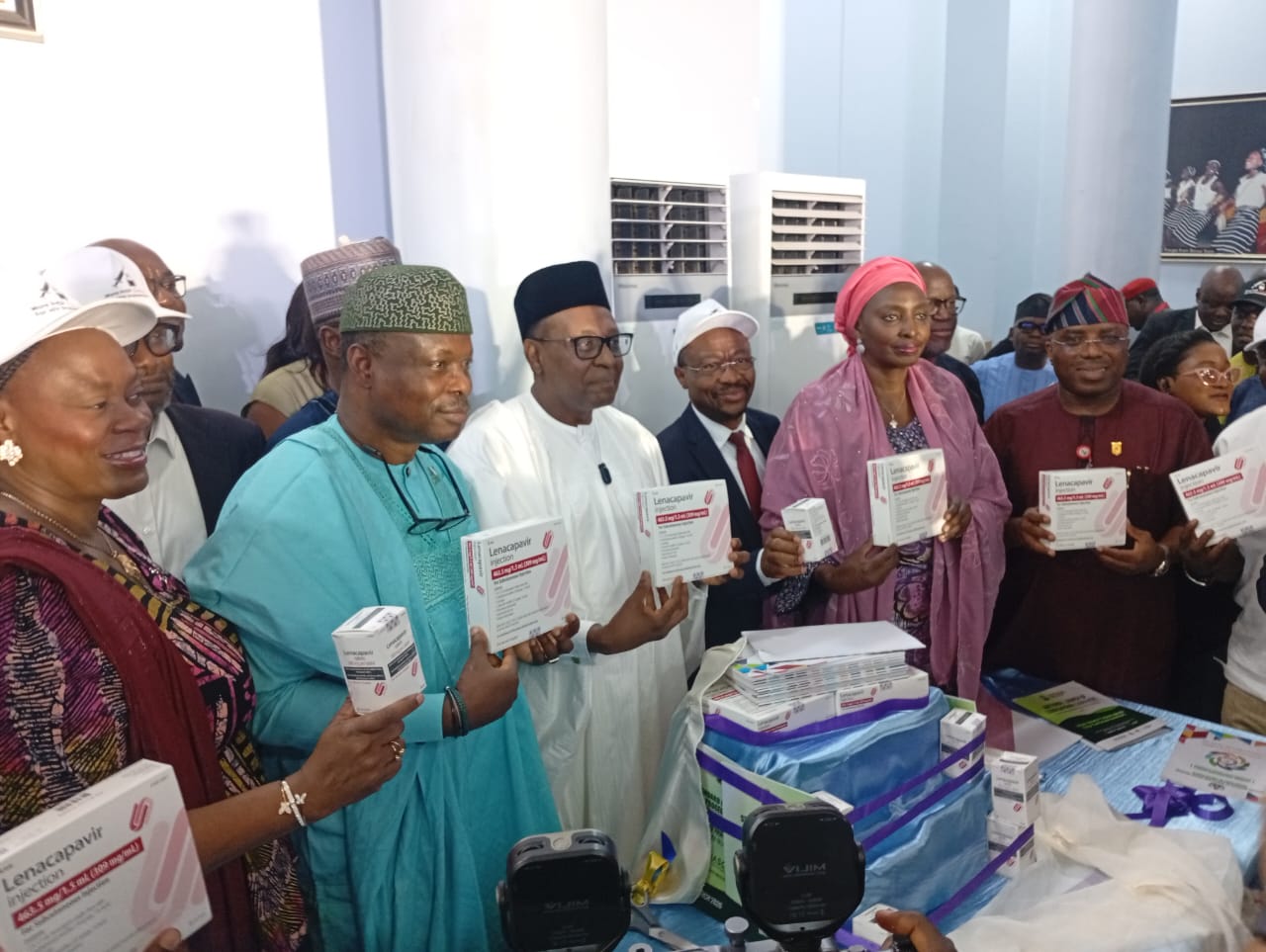
The Coordinating Minister of Health and Social Welfare, Prof. Mohammad Ali Pate, on Tuesday declared that Nigeria now has the tools and political backing to end HIV, Tuberculosis (TB) and malaria, following the national launch of Lenacapavir (LEN PrEP) and the 2026 World Tuberculosis Day commemoration in Abuja.
The event was organized by the National Aids, Viral Hepatitis and STIs Control Programme (NASCP), of the Federal Ministry of Health and Social Welfare
Pate said the Federal Government is scaling up domestic financing and embracing innovation to confront emerging global health funding challenges.
“In such times, it’s innovations that will allow us to get ahead of the challenges… with tools like Lenacapavir, we now have another instrument that can help us finish the work that we know we can do,” he said.
He disclosed that Nigeria has committed an additional $346 million in co-financing for HIV, TB and malaria programmes in the 2026 budget.
“The only way that will happen is if Nigeria puts its own money where it matters for the health sector… otherwise, we’ll continue to be begging for funds, and we don’t want to do that,” Pate added.
He further revealed that the government is making its largest-ever investment in tuberculosis control to prevent drug shortages and expand treatment coverage.
“This will be the largest… more than 50 times what we had ever put into TB commodities,” he said, stressing that efficient use of resources and integrated service delivery remain central to achieving results.
Also speaking, the Minister of State for Health and Social Welfare, Dr. Iziaq Adekunle Salako, described the launch of Lenacapavir and the Multisectoral Accountability Framework for TB (MAF-TB) as a turning point in Nigeria’s health response.
“Today reflects an intentional shift toward a health system that is innovative, integrated and accountable,” Salako said.
He noted that under the Nigeria Health Sector Renewal Investment Initiative, the country has moved to a Sector-Wide Approach that aligns all resources behind national priorities.
Salako highlighted significant progress in TB control, with case notifications rising from 138,591 in 2020 to 440,000 in 2025, alongside a treatment success rate of 94 per cent.
He added that Nigeria is nearing global HIV targets, with 93 per cent of people living with HIV aware of their status, 99 per cent on treatment and 95 per cent achieving viral suppression.
Describing Lenacapavir as “transformative,” Salako said the twice-yearly injectable offers a discreet and highly effective prevention option, particularly for individuals who struggle with daily medication adherence.
“The introduction of Lenacapavir represents a major advance in HIV prevention and will help us sustain the gains we have made,” he said.
Representing the World Health Organisation (WHO), Dr. Pavel Ursu, who spoke on behalf of the Country Representative, described the launch as a milestone not just for Nigeria but for the African region.
“This is a major moment for Nigeria and Africa. The rapid adoption of the twice-yearly Lenacapavir highlights strong national commitment to reducing new infections,” Ursu said.
He commended Nigeria’s leadership in integrating TB and HIV services, stressing that ending both diseases requires coordinated, multi-sectoral action.
“With Nigeria’s leadership and commitment, ending TB and HIV as public health threats by 2030 is not only possible, it is achievable,” he added.
Also speaking, the Permanent Secretary, Federal Ministry of Health and Social Welfare, Kachollom Shangti Daju, described the event as a major milestone in Nigeria’s public health response.
“Today’s gathering is more than a ceremonial observance. It marks two significant milestones the national launch of Lenacapavir for HIV prevention and the unveiling of the multisectoral accountability framework for TB,” she said.
Daju noted that the introduction of Lenacapavir offers new hope, particularly for populations at higher risk of HIV infection.
“This long-acting injectable aligns with our national strategy to expand prevention options, reduce new infections and move closer to achieving epidemic control,” she added.
She reaffirmed government’s commitment to increasing domestic funding and strengthening community engagement in tackling both diseases.
Director of Public Health, Dr. Charles Nzelu, said the dual event reflects Nigeria’s strategic shift towards integration, innovation and accountability in healthcare delivery.
“The introduction of Lenacapavir provides a transformative approach to expand HIV prevention, while the TB accountability framework strengthens coordination and tracking of commitments,” he said.
Nzelu added that the government is prioritising integrated HIV-TB services, noting that collaboration is critical to reducing disease burden and improving patient outcomes.
In his remarks, the Global Fund representative, Jean-Thomas Nouboussi, described the rollout of Lenacapavir as a “game changer” in HIV prevention.
“It addresses one of the key challenges in HIV prevention adherence to daily medication and offers hope for reaching populations previously underserved,” he said.
Nouboussi revealed that Nigeria is among nine early adopter countries and is expected to receive 179,700 doses of the drug by 2028.
He, however, urged the government to sustain funding and ownership of health programmes.
“Ending TB depends on strong national commitment and sustainability. We expect no interruption in funding, as that could reverse the gains already made,” he said.
The event highlighted Nigeria’s renewed push to leverage innovation, strengthen partnerships and increase domestic investment in order to eliminate HIV and tuberculosis as public health threats.
Also lending his voice, Director-General of the National Agency for the Control of AIDS (NACA), Dr. Temitope Ilori, described the rollout of Lenacapavir as a major breakthrough in HIV prevention.
“This is a prevention strategy, not a treatment strategy, but an innovation that will improve adherence and compliance, and significantly reduce new HIV infections,” Ilori said.
She emphasised the importance of collaboration, noting that the convergence of stakeholders at the event reflects a united front against HIV and tuberculosis.
“Together, we can stop TB, together we can stop HIV infections, and together we can ensure these diseases are no longer public health threats in Nigeria by 2030,” she added.
On his part, Chief Executive Officer of the Institute of Human Virology Nigeria (IHVN), Dr. Patrick Dakum, said Nigeria had long embraced integrated HIV and TB programming, noting that joint funding applications for both diseases had been in place for years.
“No longer HIV or TB — it is HIV and TB together. Detection, prompt treatment and prevention are key to ending both diseases,” Dakum said.
He assured that implementing partners remain committed to translating policies into real impact at the community level.
“Our goal is to ensure speed and efficiency in implementation. With the leadership we have, this is a winnable fight,” he stated.
Board Chair of the Stop TB Partnership Nigeria, Dr. Queen Ogbuji-Ladipo, called for sustained domestic financing to consolidate gains made in TB control.
“Ending TB in Nigeria is achievable with strong government leadership and empowered communities, but this progress must be matched with sustainable funding,” she said.
She urged all levels of government and the private sector to increase investments, warning that declining global funding makes domestic resource mobilisation more critical than ever.
“Let us move beyond promises to decisive action and measurable results,” she added.
From the community perspective, National Coordinator of the Network of People Living with HIV/AIDS in Nigeria (NEPWHAN), Mr. Abdulkadir Ibrahim, acknowledged progress but warned that new infections remain a concern.
“We still record about 48,000 new HIV infections annually. That shows more effort is needed,” he said.
He described Lenacapavir as a promising tool that could help close prevention gaps if properly scaled.
“We hope this innovation will be successfully implemented and expanded to avert new infections and achieve zero transmission goals,” he added.
Also speaking, Project Lead at Root to Rise, Adaobi Olisha, described the launch as a celebration of innovation, partnerships and resilience in the face of global funding challenges.
“Lenacapavir represents more than a new prevention option — it represents choice, dignity and progress,” she said.
Olisha stressed the need for strong community engagement and health system readiness to ensure the innovation reaches those who need it most.
“We must ensure sustained demand, community-led delivery and system capacity to scale this intervention nationwide,” she said.
She commended the Federal Government, development partners and community actors for their role in bringing the innovation to reality.
Stakeholders across board reiterated that the combined launch of Lenacapavir and the TB accountability framework signals a new phase in Nigeria’s fight against the two diseases, anchored on innovation, integration and sustainability
The event was organized by the National Aids, Viral Hepatitis and STIs Control Programme (NASCP), of the Federal Ministry of Health and Social Welfare.
Stakeholders across board reiterated that the combined launch of Lenacapavir and the TB accountability framework signals a new phase in Nigeria’s fight against the two diseases, anchored on innovation, integration and sustainability.