



Nigeria has called for a new model of economic partnership with Africa that prioritises national sovereignty, domestic investment, local industrial processing and infrastructure capable of generating sustainable growth.
The Minister of State for Foreign Affairs, Ambassador Sola Enikanolaiye, made the call at the Berlin Global Dialogue 2026 in Germany, arguing that foreign investment should complement, rather than replace, Africa’s efforts to mobilise its own financial resources.
“Africa has come to this conversation with great assets, substantial opportunities and a determination to shape its own development based on partnership with the rest of the world,” Enikanolaiye said.
Speaking at a high-level panel on trade, technology and geopolitical power and a policy lab on infrastructure and investment, the minister outlined Nigeria’s position on strategic autonomy, economic integration and the need for investment partnerships that deliver measurable benefits to African countries.
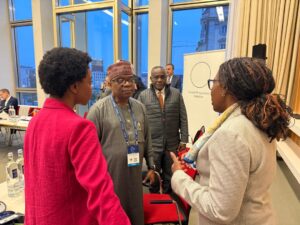
He said Africa’s engagement with global powers should be guided by mutual respect, shared prosperity and the continent’s development priorities rather than rigid political alliances.
On the relationship between foreign policy and business, Enikanolaiye argued that Africa’s historical experience with external commercial interests should encourage governments to strengthen domestic capital formation and indigenous enterprise.
“Foreign capital can only complement but cannot replace the kind of resources that we need,” he said, citing the scale of African investment opportunities and the need to mobilise local resources.
He described Nigeria’s strategic autonomy as the freedom to engage different international partners according to national interests, regardless of their ideological or political affiliations.
“It allows us a space of action regardless of ideology or political complexion of the various blocs to advance our own national interest, including those of Nigerian companies,” he said.
Nigeria pushes local processing of mineral resources
The minister also called for an end to the export of raw minerals without sufficient domestic processing, insisting that African countries should capture more economic value from their natural resources.
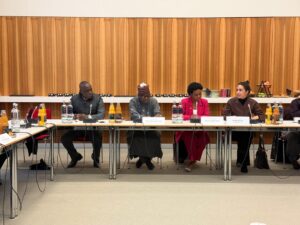
He said Nigeria’s policy was increasingly focused on requiring investors to establish local processing industries, alongside stronger oversight of environmental protection and the rights of host communities.
“We learned from our experience in the Niger Delta. We are now doing things differently to give rights to local communities where minerals are found,” Enikanolaiye said.
The position reflects Nigeria’s broader ambition to expand domestic manufacturing, create jobs and ensure that resource extraction delivers greater benefits to local economies.
He also cited Nigeria’s historical role in regional stabilisation, including its participation in ECOMOG operations in Liberia and Sierra Leone, as an example of how security and diplomacy can create conditions for businesses to expand across borders.
Infrastructure financing and power supply in focus
On infrastructure, Enikanolaiye identified reliable electricity, efficient transport networks and wider digital connectivity as essential to expanding production and creating employment for Africa’s growing population.
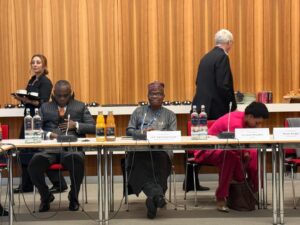
He called for more long-term investment in bankable projects, stressing that investors require predictable regulations, transparent procurement processes, well-prepared projects and credible mechanisms for sharing risk.
The minister highlighted the roles of the African Export-Import Bank, the African Development Bank and the ECOWAS Bank for Investment and Development in supporting infrastructure financing through guarantees and blended finance.
He also welcomed the development of an African Credit Rating Agency, arguing that reform of international credit-rating systems was important to improving the continent’s access to affordable capital.
Enikanolaiye linked Africa’s technological ambitions, including artificial intelligence, to the need for reliable electricity and stronger digital infrastructure.
He further identified electricity metering as an investment opportunity, noting its potential to improve revenue collection and support the financial sustainability of power systems.
Nigeria advocates stronger African trade
The minister called for stronger intra-African trade and economic integration, citing the African Continental Free Trade Area (AfCFTA), Nigeria’s trade single-window system and the Pan-African Payment and Settlement System (PAPSS) as important mechanisms for improving commercial exchanges.
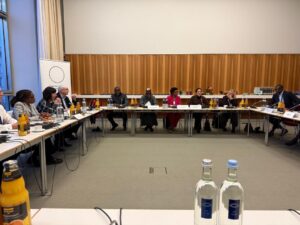
He referred to Africa’s reported average economic growth of 4.3 per cent and an ambition to raise growth to 7 per cent, arguing that stronger regional trade could help build competitive industries and expand economic opportunities.
“We need to trade more among ourselves to develop competitive advantages,” he said.
He also highlighted technical education, workforce skills and diaspora remittances as important sources of support for infrastructure development, particularly as traditional development assistance faces pressure.
Enikanolaiye concluded by urging African governments and partners to mobilise long-term capital while strengthening fiscal discipline, transparency, democracy and the rule of law.
Nigeria and Lesotho explore deeper diplomatic ties
On the sidelines of the Berlin dialogue, the Nigerian delegation also held a bilateral meeting with Lesotho’s Foreign Minister, Limpho Justice Tau, to explore closer cooperation between both countries.
The delegation, representing President Bola Tinubu, was led by Enikanolaiye and the Minister of Budget and Economic Planning, Senator Abubakar Atiku Bagudu. Nigeria’s Ambassador to Germany, Senator Ita Enang, also participated in the meeting.
The discussions included the possibility of establishing a physical diplomatic presence for Lesotho in Abuja and expanding economic cooperation.
Tau commended Nigeria’s historical contribution to African liberation efforts and invited Nigerian industrialists, including the Dangote Group, to explore investment opportunities in Lesotho.
The meeting is expected to support further cooperation through the African Union Development Agency–New Partnership for Africa’s Development (AUDA-NEPAD).
The engagements underscore Nigeria’s push to combine diplomatic influence with commercial partnerships, infrastructure investment and stronger African economic integration.