


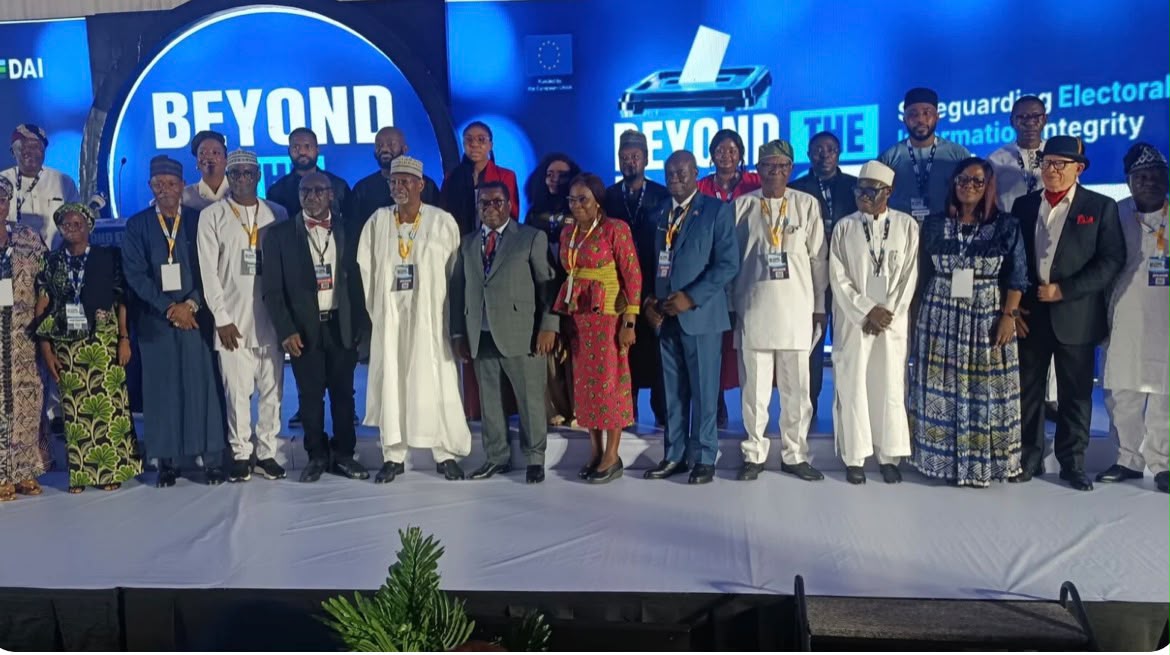
Executive Director of the IPC, Dr Lanre Arogundade, raised the concern on Monday at the opening of a two-day National Summit on Electoral Information Integrity in Abuja, where he called for a coordinated national response to emerging threats to electoral information.
Arogundade said findings attributed to the Nigeria Fact-Checkers Coalition showed that 63 per cent of presidential and National Assembly-related claims reviewed during the 2023 elections were entirely false, while misleading claims spread to secondary social media platforms within an average of 11 minutes.
He warned that the growing influence of social media, voice cloning, forged election result sheets and other forms of digitally manipulated content could make it increasingly difficult for Nigerians to distinguish authentic electoral information from deliberate falsehoods.
The IPC director also cited figures indicating that Nigeria had approximately 148 million internet users, while a recent survey showed that 52 per cent of Nigerians relied primarily on social media for political news.
According to him, the proportion exceeded 82 per cent in the South-East, where more than four in 10 voters reportedly did not verify information obtained through social media platforms.
Arogundade cautioned that the problem extended beyond the circulation of fabricated information, warning that genuine evidence could also be dismissed as AI-generated content, potentially weakening accountability and public trust.
He called for the establishment of an Electoral Information Integrity Response Protocol and the adoption of an Abuja Commitment to provide a framework for coordinated action before, during and after the 2027 elections.
“Awareness alone is insufficient. Nigeria needs a trusted, coordinated, rights-respecting system enabling institutions to anticipate threats, verify evidence, escalate incidents, and communicate authoritatively,” he said.
Also speaking, the European Union Ambassador to Nigeria and ECOWAS, Gautier Mignot, warned that electoral processes could be undermined without any interference with ballot papers or voting equipment.
He explained that fabricated announcements and false claims about election results could create confusion, deepen suspicion and weaken confidence in electoral institutions.
“An election can be undermined without a single ballot being altered. A fabricated announcement can send voters to the wrong location.
“A false claim about results can deepen suspicion before verified information reaches the public. The immediate target is information; the deeper target is trust,” Mignot said.
The EU envoy said information manipulation was becoming an increasingly serious challenge across Europe and Africa, with advances in artificial intelligence making deceptive content easier to produce and harder to detect.
However, he cautioned against treating technology as the only dimension of the problem, noting that misleading information could cause harm even without sophisticated AI tools.
“The task is, therefore, broader than detecting deepfakes; it is to build an electoral and information environment in which reliable information is available, institutions communicate credibly, independent journalism can flourish, and manipulation meets a prepared response,” he said.
Mignot identified early preparedness, stronger partnerships and the protection of democratic rights as three priorities for Nigeria ahead of the 2027 general elections.
He urged relevant institutions to establish verification channels, clarify responsibilities and agree on procedures for issuing public corrections well before election day.
“Election day is too late to establish verification contacts, clarify responsibilities, or agree on who can authorise a public correction. Those arrangements should be developed and tested now,” he said.
The ambassador also emphasised the need to protect independent journalism and ensure that electoral institutions and digital platforms remain accountable within their respective responsibilities.
He said efforts to combat disinformation must not become a pretext for suppressing legitimate political criticism, restricting press freedom or violating citizens’ rights.
“Countering manipulation must never become a justification for silencing criticism, suppressing inconvenient reporting, or treating political disagreement as a threat,” Mignot said.
He added that citizens questioning public institutions should not automatically be regarded as spreading misinformation, while journalists reporting institutional failures were performing an important democratic function.
Mignot reaffirmed the European Union’s commitment to supporting Nigerian-led initiatives to strengthen electoral integrity without dictating the country’s political outcomes.
The concerns come as the Independent National Electoral Commission (INEC) prepares for the 2027 general elections and moves to strengthen its capacity to address emerging technological threats.
The Commission has announced the establishment of an artificial intelligence unit and assured Nigerians that algorithms would not determine the outcome of the 2027 elections.
Arogundade, however, stressed that such initiatives must be backed by adequate institutional capacity, effective coordination and appropriate safeguards before voting begins.
“We must ensure that all institutions, and systems, and the people are ready, and safeguards in place before voting begins in 2027,” he said.
The two-day summit, themed “Beyond the Ballot: Safeguarding Electoral Information Integrity in the Age of AI,” was organised by the International Press Centre in collaboration with the Centre for Media and Society (CEMESO) and Development Alternatives Incorporated (DAI), with support from the European Union Support to Democratic Governance in Nigeria (EU-SDGN).


