


The molecules don’t lie — and this time, they crossed a major river.
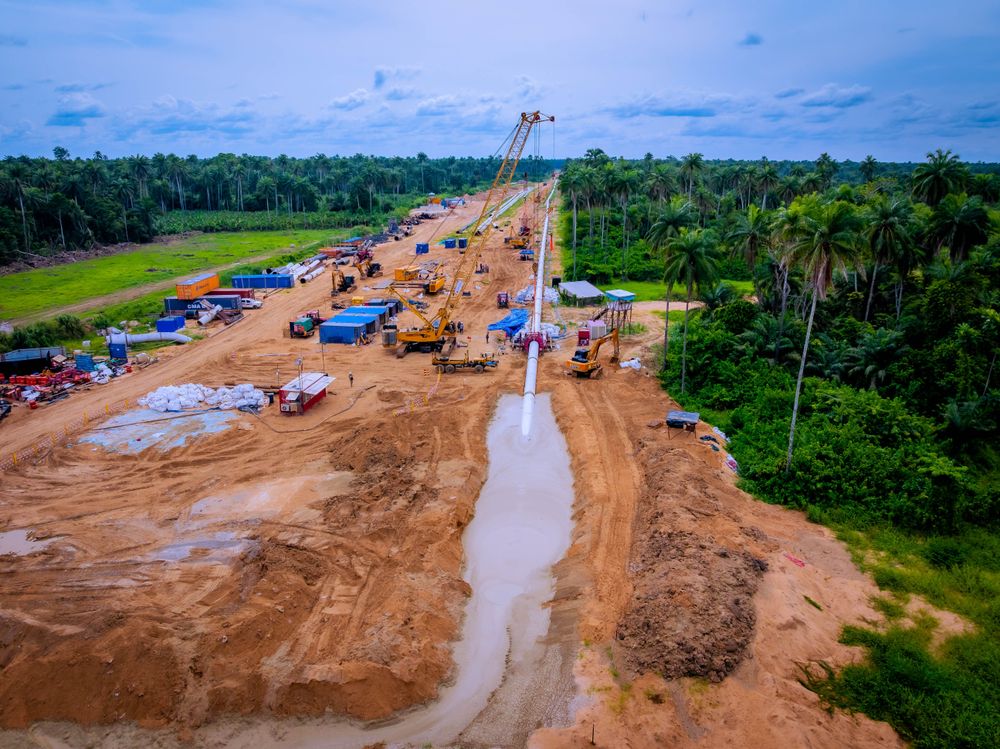
NNPC Gas Infrastructure Company (NGIC), a wholly owned subsidiary of NNPC Limited, has successfully completed the technically demanding River Niger Crossing on the 130-kilometre Obiafu-Obrikom-Oben (OB3) Gas Pipeline. This milestone marks a significant step toward stitching Nigeria’s eastern gas production heartland into a truly national transmission network.
Announced on Thursday by Andy Odeh, Chief Corporate Communications Officer of NNPC Ltd, the crossing was executed approximately two kilometres beneath the riverbed using advanced horizontal directional drilling (HDD) technology. The operation, carried out by the NNPC project team in partnership with PCE Nig. Limited, overcame one of the most challenging sections of the pipeline in the Niger Delta environment.
Once fully operational, the OB3 pipeline is engineered to transport up to 2 billion standard cubic feet of gas per day (Bscfd)**. Its completion strengthens supply reliability, deepens domestic gas utilisation, bolsters power generation, and provides a firmer foundation for industrial growth and regional exports.
Group Chief Executive Officer of NNPC Limited, Engr. Bashir Bayo Ojulari, described the achievement as more than an engineering feat — it is tangible proof of disciplined execution.
“The completion of the OB3 River Niger Crossing is a defining milestone for Nigeria’s gas infrastructure and a clear demonstration of what disciplined execution and sustained commitment to excellence can deliver,” Ojulari stated.
He emphasised that the team deliberately built on lessons from the AKK Pipeline’s River Niger Crossing completed in June 2025. Through rigorous project governance, innovative engineering solutions, and adaptive problem-solving, NNPC and its partner delivered an even more complex crossing this time.
“This achievement is not incidental,” the GCEO added. “It is the result of deliberately leveraging and upscaling our AKK engineering and execution excellence… The OB3 Pipeline is central to our ambition of building an integrated and resilient gas network that underpins Nigeria’s energy security and economic development.”
Ojulari commended the doggedness of the NNPC project team, NGIC management and staff, and the professionalism of PCE Nig. Limited, whose innovative approach and disciplined workforce proved pivotal. He also expressed appreciation to host communities for their consistent support.
The milestone arrives against the backdrop of the Federal Government’s ambitious targets: 3 million barrels per day of crude oil and 12 billion standard cubic feet per day of gas production by 2030. With the successful River Niger Crossing, Nigeria’s gas-producing regions in the east are now physically interconnected with western demand centres and positioned to feed the northern corridor via the AKK Pipeline.
In the near term, authorities expect the development to unlock over 500 million standard cubic feet per day of incremental gas supply to the domestic market. This additional volume can directly support struggling power plants, fuel industrial expansion, and open opportunities for West African gas trade.
Ojulari acknowledged the enabling role of the Federal Government under President Bola Ahmed Tinubu’s Gas-to-Prosperity agenda, which has helped create a more conducive environment for such strategic projects. He also thanked the NNPC Board of Directors, chaired by Engr. Ahmadu Musa Kida, for its guidance.
“At NNPC Limited, we remain fully committed to translating Nigeria’s oil and gas resources into a better standard of living for all citizens,” Ojulari reaffirmed. “We will continue to collaborate with our partners to deliver projects that expand energy availability, stimulate industrialisation, and improve the overall wellbeing of Nigerians.”
From an infrastructure standpoint, the OB3 pipeline functions as a strategic east-west backbone. Western segments have reportedly been flowing around 300 MMscfd in recent periods, but the full integration promised by completing the River Niger section removes a long-standing bottleneck. This interconnection is particularly timely as Nigeria eyes July 2026 for initial gas deliveries to Abuja through the AKK pipeline, which depends heavily on robust southern supply from lines like OB3.
For years, Nigeria has talked about moving from oil dependence toward a gas-powered economy. Projects like OB3 turn that rhetoric into physical reality — kilometres of steel pipe buried deep beneath one of Africa’s great rivers. The physics and capital have aligned here. What remains is consistent upstream delivery, commercial discipline, and downstream offtake that actually pays.
The successful crossing of the River Niger on OB3 is not the finish line. It is, however, a clear signal that Nigeria’s gas infrastructure ambitions are moving from aspiration to execution. When east meets west beneath the river, the potential for genuine energy security and industrial revival rises with it.


