


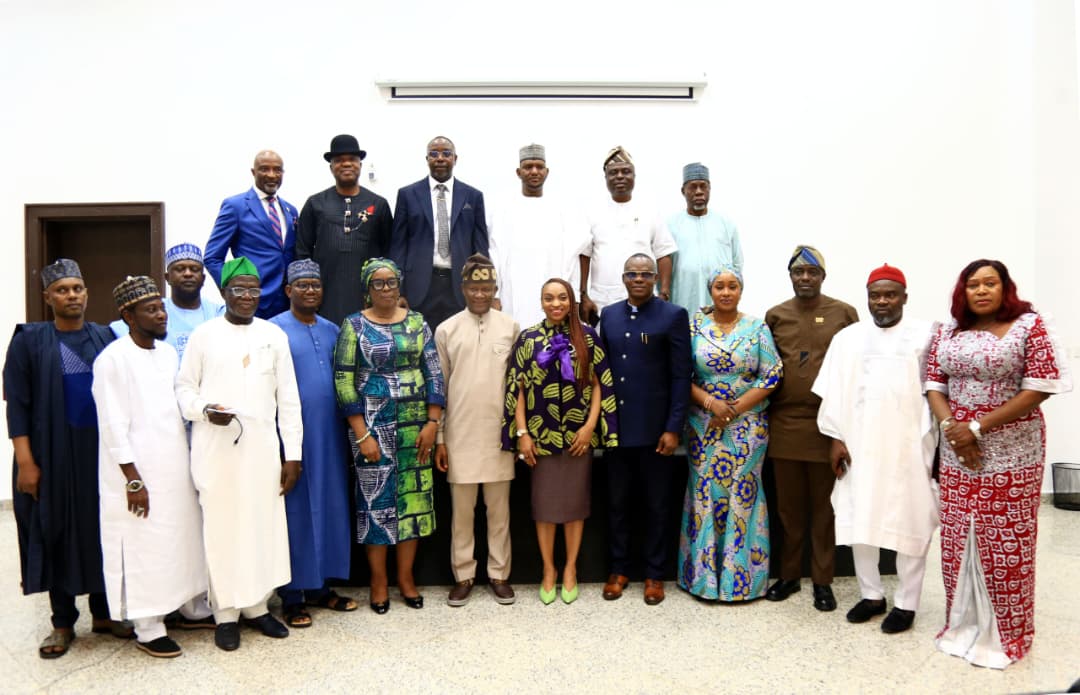
ABUJA — The Federal Ministry of Industry, Trade and Investment (FMITI) is intensifying its push for export-led growth and industrial expansion, strengthening strategic collaboration with state governments following a notable rise in Nigeria’s non-oil exports.
Minister of Industry, Trade and Investment, Dr. Jumoke Oduwole, said non-oil exports increased by 11 per cent to more than $6 billion, signalling growing traction in the country’s economic diversification efforts.
The growth, driven largely by Micro, Small and Medium Enterprises (MSMEs), is shaping a shift in Nigeria’s trade structure, with policymakers focusing on sustaining momentum through deeper federal-state coordination.
The renewed alignment with state governments is positioned as critical to unlocking production capacity, scaling exports and accelerating industrial development across key sectors of the economy.

Push for Export Readiness
To consolidate gains, FMITI has rolled out nationwide export readiness and capacity-building programmes aimed at addressing structural bottlenecks, including production standards, regulatory compliance and market access.
The initiative targets MSMEs, which account for a significant share of non-oil exports but continue to face limitations in scaling operations and meeting international standards.
AfCFTA Reshapes Trade Direction
Nigeria’s trade flows are increasingly tilting towards African markets under the African Continental Free Trade Area (AfCFTA), with exports to the continent now surpassing those to other regions.
The development is being leveraged as a strategic opportunity to deepen intra-African trade, expand market access and attract investment into priority sectors.
Nigeria’s expected assumption of the Chairmanship of the AfCFTA Council of Ministers is also seen as strengthening its role in shaping continental trade policy and advancing its economic interests.
Industry Agenda Gains Ground
Minister of State for Industry, Senator John Owan Enoh, underscored the importance of state-level execution in achieving national industrialisation goals, noting that the bulk of productive assets are located within sub-national jurisdictions.
Ongoing initiatives include the implementation of Nigeria’s industrial policy and the expansion of programmes such as industrial parks and value chain development, which rely heavily on state collaboration.
Bridging Policy and Implementation
Permanent Secretary of FMITI, Dr. Chris Osa Isokpunwu, highlighted the need to close the gap between policy formulation and execution, with states expected to drive industrial clusters, MSME development and export expansion.
He confirmed that the 17th National Council on Industry, Trade and Investment will hold in Enugu State from July 20 to 24, 2026, as part of efforts to strengthen coordination and policy alignment.
States Align with Federal Strategy
State governments, represented by the Forum of Commissioners for Commerce and Industry, signalled readiness to align with the federal government’s agenda, reinforcing a unified approach to industrialisation, investment promotion and trade competitiveness.
Outlook
With export growth gaining momentum and new opportunities emerging under AfCFTA, policymakers are betting on stronger federal-state coordination to reduce reliance on oil revenues and build a more resilient, export-driven economy.