


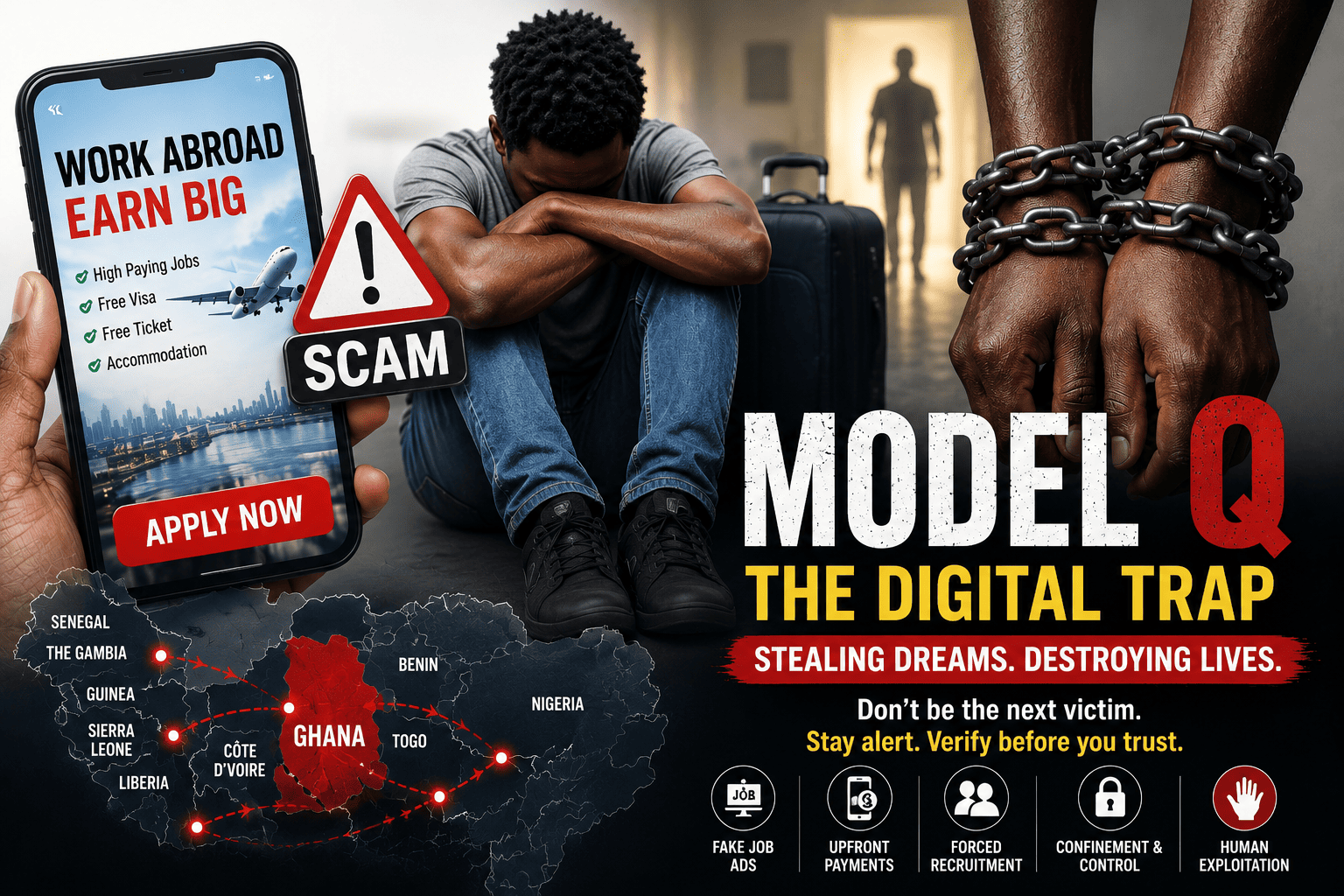
A message pops up on your phone.
“Job opportunity abroad. No experience needed. Travel covered.”
For thousands of young people across West Africa, that message has become the beginning of a nightmare.
Authorities are now warning about a fast-growing trafficking system known as “Model Q”—a digital-first criminal network that is quietly luring victims through social media, fake job platforms, and messaging apps, then trapping them in cycles of exploitation that are increasingly difficult to escape.
What makes this threat different is not just its scale—but how easily it starts.
It Starts With a Click
Unlike traditional trafficking, Model Q does not begin in back alleys or motor parks. It begins online—on Facebook, WhatsApp, Telegram, and even professional job platforms.
The offers look real.
Well-designed websites. Convincing testimonials. Polished recruiters. Some victims are even approached by people they know—friends, classmates, or distant relatives—who appear to be living successful lives abroad.
All that is required is a small “processing fee.”
For many, it feels like a risk worth taking.
But once the payment is made and the journey begins, the story changes.
From Opportunity to Captivity
Victims who travel—often across nearby borders—quickly discover the truth.
There is no job.
Instead:
– Passports are confiscated
– Phones are monitored
– Movement is restricted
– Communication is controlled
Some are held in apartments. Others in isolated compounds.
Many are subjected to intense psychological pressure. In some cases, ritual practices are used to instill fear and prevent escape.
And then comes the most disturbing twist
Forced to Recruit Others
Victims are not just exploited—they are turned into recruiters.
Under coercion, they are made to contact friends and family back home, convincing them to join the same “opportunity.” They post photos online, pretending everything is fine.
This creates a dangerous cycle:
Victims become promoters. Promoters create new victims.
The system grows rapidly—without traffickers exposing themselves.
Authorities say this is what makes Model Q especially difficult to dismantle.
It feeds on trust.
The Case That Raised Alarm
In Ghana, a disturbing case exposed how far traffickers are willing to go.
A man repeatedly entered the country and married multiple women over time. Each marriage appeared genuine. Families accepted him.
But by the fourth marriage, suspicions grew.
Investigations revealed a hidden operation: the women were being transported out of the country and forced into sexual exploitation abroad.
The marriages were a cover.
The case shocked investigators and highlighted a new reality—trafficking is no longer just about strangers. It can come through relationships, trust, and carefully planned deception.
219 Victims Rescued in Major Operation
In one of the largest recent crackdowns, security agencies in Ghana rescued 219 individuals from a trafficking and cybercrime operation in Oyarifa, Accra.
Many of the victims had been lured with job offers.
Instead, they were confined and forced into online fraud—scamming victims across different countries.
Nineteen suspects were arrested.
Authorities say the case reveals how trafficking networks are merging with cybercrime, turning victims into tools for digital exploitation.
A Growing Pattern Across West Africa
Similar cases are emerging across the region:
– Dozens of victims rescued after being lured with fake job offers abroad
– Young people trapped in pyramid-style recruitment schemes
– Victims forced into online scams after being trafficked
– Cross-border movements used to hide operations
In one case, a father reported his missing children—leading to the rescue of over 30 victims in a joint international operation.
The pattern is clear.
The method is evolving.
And the numbers are rising.
Why So Many Are Falling Victim
Experts say Model Q is spreading quickly because it exploits real struggles:
Unemployment: Many young people are desperate for opportunities
Digital access: Smartphones make it easy to reach victims directly
Trust networks: Friends unknowingly recruit friends
Easy payments: Mobile money allows quick, untraceable transactions
Open borders: Movement within the region is relatively simple
It is a system built around hope—and designed to exploit it.
What Authorities Are Doing
Governments and international agencies are stepping up efforts to stop the spread.
Security agencies are now:
– Tracking financial transactions linked to trafficking networks
– Monitoring suspicious online recruitment platforms
– Strengthening cross-border intelligence sharing
– Coordinating operations through INTERPOL
Workshops and joint task forces are being used to turn intelligence into action.
But officials admit the fight is complex.
This is not a local crime. It is a network without borders.
What You Should Watch Out For
Authorities are urging the public to stay alert.
Warning signs include:
– Job offers that require upfront payment
– Recruiters who avoid official verification
– Offers that seem too good to be true
– Pressure to act quickly without proper documentation
The most important rule:
If you cannot verify it independently, do not trust it.
The Bigger Danger
Model Q is not just another scam.
It represents a shift in how organized crime operates—using technology, psychology, and social networks to scale exploitation faster than ever before.
It turns victims into participants.
It hides behind trust.
And it spreads with every click.
A Generation at Risk
West Africa’s youth are among the most connected in the world—and among the most targeted.
For many, the dream of a better life is real.
But so is the danger.
As authorities intensify the crackdown, one message is becoming clear:
The fight against Model Q will not be won by law enforcement alone.
It will require awareness, caution, and collective vigilance.
Because today, the most dangerous journeys don’t begin at the airport—
They begin on your phone.