


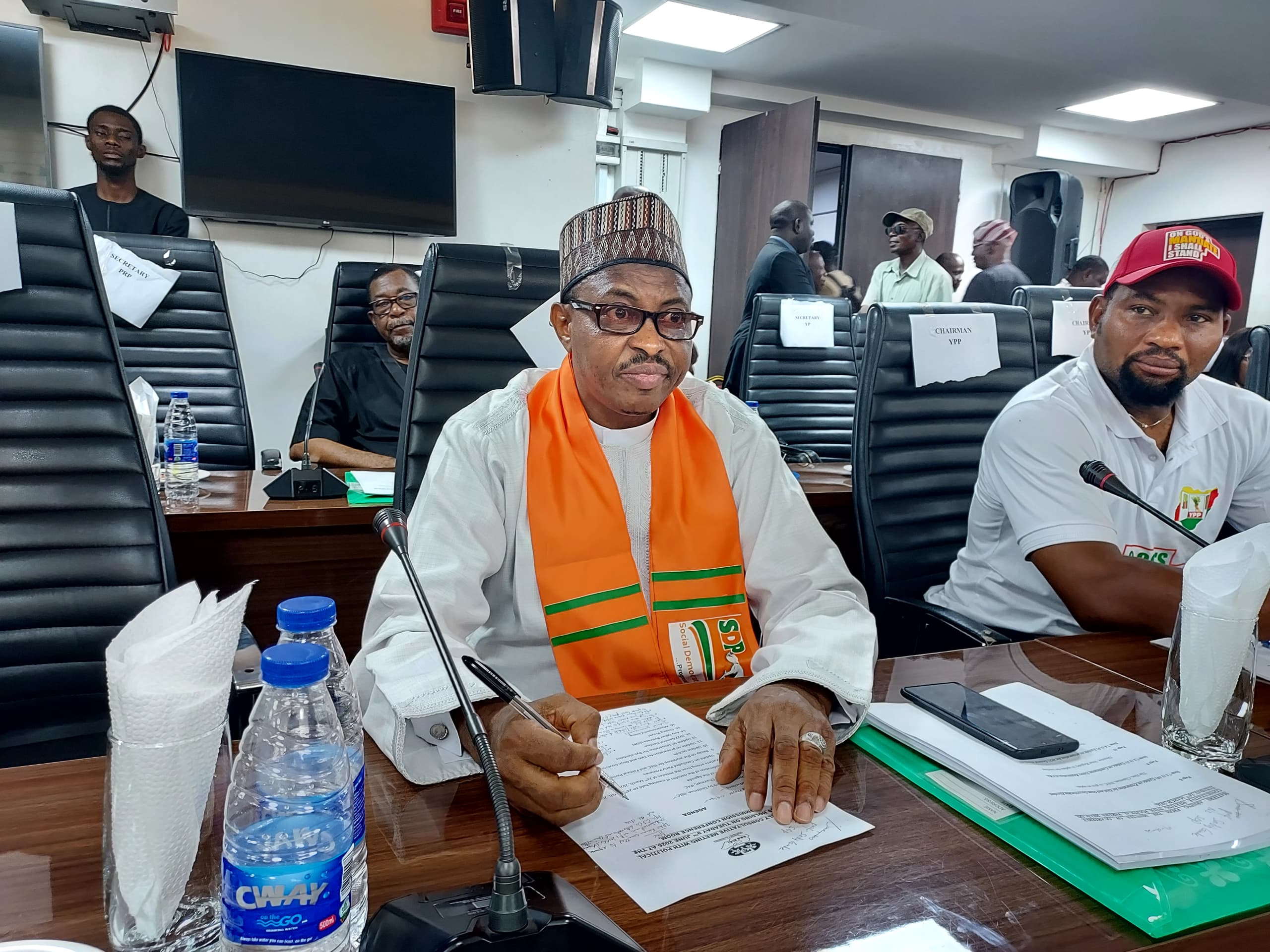
The leadership battle in the Social Democratic Party (SDP) escalated on Tuesday as Professor Sadiq Umar Abubakar Gombe declared that he remains the legitimate National Chairman of the party, insisting that no individual or INEC portal can determine who leads the SDP.
Speaking after a consultative meeting convened by the Independent National Electoral Commission (INEC) with leaders of registered political parties in Abuja, Gombe maintained that the party’s constitution and organs, not the electoral umpire’s portal, have the final say on leadership matters.
According to him, the Supreme Court has already affirmed that leadership issues are internal affairs of political parties.
“So, the issue is not about the INEC portal. We have severally told you that the issue of party leadership is an exclusive preserve of the political party to decide on its leadership. The Supreme Court has separately ruled in this respect,” Gombe said.
“The INEC portal doesn’t determine who is chairman of a political party. It is the party itself. The party has organs that regulate its day-to-day running.”
The SDP chairman defended the expulsion of former National Chairman, Shehu Musa Gaban, and other party members, saying due process was followed before disciplinary actions were taken.
He disclosed that the party’s National Working Committee (NWC), which originally had 15 members, now has 11 after disciplinary measures were taken against four members.
“The National Working Committee initially had 15 members. Four of the members were disciplined. One resigned and apologised to the party, while the remaining three, including Shehu Musa Gaban, were expelled after due process,” he stated.
Gombe said a disciplinary committee was constituted to investigate the affected members and provide them fair hearing, but they allegedly refused to appear before the panel.
“We set up an investigation committee to give them fair hearing, which they refused to participate in. Our constitution is clear. Article 19(C) provides that if you are not satisfied with any disciplinary action, you have five working days to appeal through the party’s internal mechanism.
“Neither Gaban nor the others appealed through the party structure. Neither did they obtain any court order setting aside their expulsion,” he added.
The SDP boss insisted that the party’s National Executive Committee (NEC), being the highest implementing organ of the party, acted within its constitutional powers and that its decisions remain valid and binding.
Expressing confidence in INEC, Gombe said the commission would ultimately uphold the rule of law and respect the independence of political parties.
“We are law-abiding citizens and we are confident in the ability of INEC to do the needful. We are not doubting their competence and commitment to the rule of law and to the independence of political parties,” he said.
Gombe further revealed that he possesses certified true copies of both the Supreme Court judgment and the SDP NEC report, which he said was certified by INEC.
He recalled that INEC monitored the party’s NEC meeting held at Newton Park Hotel on March 9, 2026, and later conducted verification exercises at the party’s national headquarters on April 21.
“We are happy with what happened today. We are happy that the INEC chairman reiterated the Commission’s commitment to the rule of law and respect for the internal affairs of political parties,” he said.
Earlier, INEC Chairman, Prof. Joash O. Amupitan, SAN, described political parties as critical partners in sustaining Nigeria’s democracy and said the meeting came at a crucial stage of the nation’s electoral calendar.
“Political parties are not merely contestants in elections; they are critical stakeholders and indispensable partners in the consolidation of constitutional democracy in Nigeria,” Amupitan stated.
Also speaking, National Chairman of the Inter-Party Advisory Council (IPAC), Dr. Yusuf Mamman Dantalle, called for urgent amendments to the Electoral Act 2026, warning that challenges experienced during the recently concluded primaries could undermine the electoral process if left unresolved.
Dantalle argued that the exclusion of indirect primaries under Section 84(2) of the Electoral Act imposed huge financial and logistical burdens on political parties and contributed to disputes that have now found their way to the courts.
“The experience of the just-concluded nomination exercise demonstrates that the removal of indirect primaries created considerable constraints for political parties,” he said.
He urged the National Assembly to urgently review the Electoral Act, condemned recent political violence in Osun State and called on politicians to embrace issue-based campaigns as the country moves closer to the 2027 general elections.
The meeting brought together leaders of registered political parties and key electoral stakeholders as preparations for the 2027 polls gather momentum.