


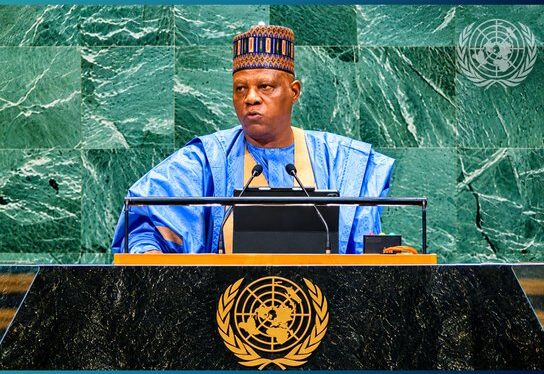
President Bola Ahmed Tinubu has renewed Nigeria’s demand for a major reform of the United Nations Security Council, calling for at least two permanent seats and five non-permanent seats for Africa.
The President made the demand in Nigeria’s statement to the 81st session of the United Nations General Assembly on Thursday, September 24. The address was delivered on his behalf by Vice President Kashim Shettima in New York.
“The reform of this institution must begin with the reconstitution of the Security Council, for the world of 2026 cannot remain captive to the distribution of power in 1945,” Tinubu declared.
Nigeria’s position is anchored in the Ezulwini Consensus and the Sirte Declaration, which form the basis of the Common African Position on Security Council reform. The African proposal seeks at least two permanent seats with the full rights and responsibilities of permanent membership, including the veto for as long as the veto remains in existence, alongside five non-permanent seats.
The current Security Council has 15 members — five permanent members and 10 non-permanent members elected for two-year terms. Africa has no permanent seat on the Council.
‘Africa cannot continue to fill the Council’s agenda’
The Nigerian position rests on what the President described as a mismatch between Africa’s role in international peace and security and its representation within the UN’s most powerful decision-making body.
“Africa cannot continue to fill the Council’s agenda while remaining absent from its permanent membership,” the statement declared.
For Nigeria, the argument is also tied to its record of participation in regional and international peace efforts. The country has committed personnel and resources to peace operations and interventions in Liberia, Sierra Leone, Darfur, Mali and The Gambia, while also working through the Economic Community of West African States, the African Union and Gulf of Guinea partnerships.
Those efforts, according to the Nigerian position, have included mediation, support for democratic governance, counter-terrorism and maritime security.
A Security Council shaped by 1945
The demand for reform comes against the backdrop of continuing international negotiations over the composition and working methods of the Security Council.
Nigeria argues that an institution created in the aftermath of the Second World War must adapt to a substantially different international system.
The broader African position has consistently sought greater representation on the Council, including permanent membership, while insisting that any African permanent members should enjoy the same rights and responsibilities as existing permanent members.
The question of the veto remains particularly contentious in the reform negotiations, with different UN member states holding competing positions on whether new permanent members should have veto powers.
Nigeria backs diplomacy over coercion
Tinubu’s call for institutional reform was accompanied by a broader defence of diplomacy as the preferred instrument for resolving international disputes.
Nigeria, according to the statement, remains committed to the UN Charter and to an international order in which “diplomacy prevails over coercion, cooperation over isolation and international law over the arbitrary exercise of power.”
The argument reflects Nigeria’s wider foreign-policy position that military responses alone cannot provide durable solutions to conflicts.
The President called for greater emphasis on peacebuilding, mediation and institution-building alongside traditional peacekeeping operations, arguing that conflict prevention should receive more resources and political attention.
“Prevention must command greater resources and political attention,” he said.
Sudan among conflicts demanding urgent diplomacy
The war in Sudan was specifically cited among the conflicts requiring urgent international diplomatic action.
Nigeria called for efforts to address the humanitarian, economic and geopolitical consequences of the conflict, while urging all parties to respect international humanitarian and human rights law, protect civilians and allow humanitarian assistance to reach those in need.
“Negotiated settlements must respect sovereignty and territorial integrity,” the statement said.
The Nigerian position also rejected the idea that military victories alone can produce lasting peace, pointing instead to dialogue, reconciliation and inclusive political processes as essential to ending violence and sustaining peace agreements.
Nigeria seeks greater responsibility
Beyond its call for representation, Nigeria presented itself as prepared to assume greater responsibility for international peace and security.
The country’s contributions to peace efforts across West Africa and other conflict zones were cited as evidence of its willingness to shoulder international responsibilities.
Through ECOWAS, the African Union and regional security partnerships, Nigeria has continued to support efforts focused on mediation, democratic governance, counter-terrorism and maritime security, according to the statement.
The President linked this record to Nigeria’s demand for a stronger African voice in global decision-making.
“The authority to speak for humanity carries an obligation to represent it,” he declared.
‘A reformed, inclusive and effective United Nations’
Nigeria’s call for Security Council reform forms part of a broader African campaign for a more representative UN system.
The African Common Position, expressed through the Ezulwini Consensus and Sirte Declaration, seeks two permanent African seats and five non-permanent seats, with permanent members enjoying the same rights and responsibilities, including the veto for as long as that mechanism exists.
For Abuja, the issue is not simply about adding seats to the Council but about aligning the institution with the geopolitical realities of the 21st century.
Tinubu concluded by reaffirming Nigeria’s commitment to cooperation, dialogue and partnership, arguing that a “reformed, inclusive and effective United Nations” remains essential to achieving a peaceful, just and sustainable international order.
Source: Statement by President Bola Ahmed Tinubu, delivered by Vice President Kashim Shettima at the General Debate of the 81st United Nations General Assembly, September 24, 2026.