


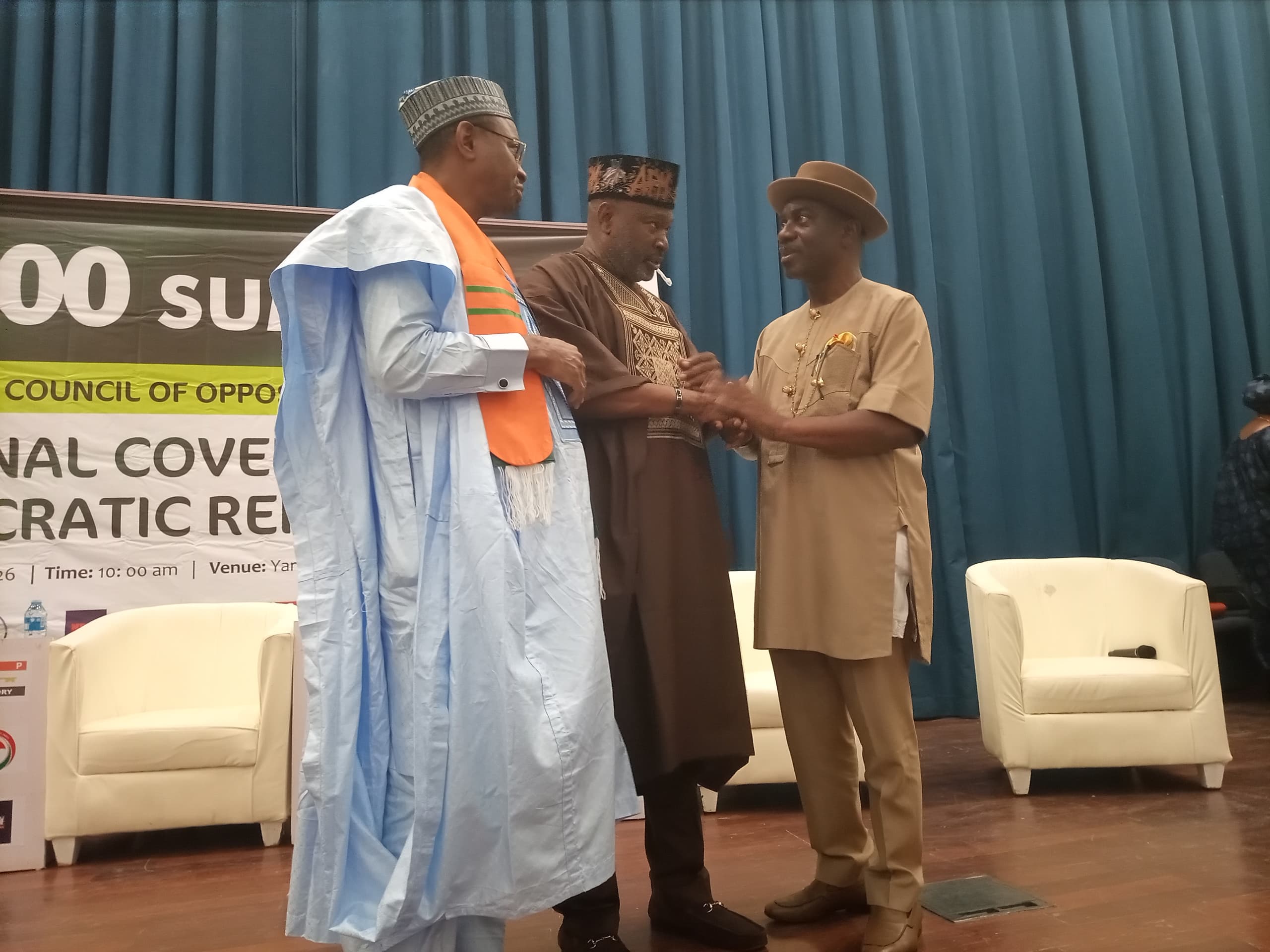
Nigeria’s opposition parties yesterday took a major step towards challenging the ruling party in 2027 as six political parties opened formal negotiations to forge a common platform and produce a single presidential candidate for the next general election.
The historic opposition summit, held at the Shehu Musa Yar’Adua Centre in Abuja, brought together presidential and vice-presidential candidates, national officers and members of Boards of Trustees of the participating parties.
Although some prominent presidential candidates, including African Democratic Congress (ADC) candidate, Atiku Abubakar; Nigeria Democratic Congress (NDC) candidate, Peter Obi; and Allied Peoples Movement (APM) candidate, Seyi Makinde, were absent, their parties were represented by senior officials.
Among the presidential candidates physically present were Social Democratic Party (SDP) candidate, Prince Adewole Adebayo, and Peoples Redemption Party (PRP) candidate, Donald Duke. APM Vice-Presidential candidate, Lawal Musa Daura, also attended.
The meeting focused on the opposition’s biggest challenge ahead of 2027 — how to bury individual ambitions, unite party structures and rally behind a common presidential candidate capable of defeating the ruling party.
The summit, facilitated by the G100, also considered a proposed framework for a Government of National Competence, based on competence, integrity, inclusion and equitable representation.
Presenting the proposal, Mallam Salihu Mohammed Lukman said the initiative must go beyond a mere merger of political ambitions.
“The Framework before you proposes something more demanding than a merger of ambitions: a Government of National Competence, built on competence, integrity, national inclusion, and fair representation of every party that contributes to the effort,” he said.
He proposed that the arrangement should be backed by a political commitment to a single four-year term contained in an enforceable Transition Charter.
Lukman warned that previous political agreements had often failed because they were based on promises without mechanisms to enforce them.
“We want to underline the word ‘enforceable.’ This gathering does not need more sincerity. Nigerian politics has never suffered from a shortage of sincere promises,” he said.
He said any agreement reached by the opposition must be written, witnessed and backed by consequences for non-compliance.
Lukman cited the 2023 presidential election as evidence of the danger of opposition parties splitting their votes among multiple candidates.
He noted that while the eventual winner secured just under nine million votes, two major opposition candidates collectively secured about 13 million votes.
“Nobody stole thirteen million votes. We divided them ourselves, in public, and we did it knowing exactly what the consequence would be,” he said.
‘We must bury our ambitions’
The Minority Leader of the House of Representatives, Hon. Fred Agbedi, who led members of the Minority Caucus to the summit, said the lawmakers were ready to work with the G100 and opposition parties to build a formidable political alliance.
“In the spirit of creating a viable opposition and ensuring that we win collectively the 2027 election, the Minority Caucus of the House of Reps decided that we partner with the G100 to see how opposition parties can come together, streamline our ambitions, and ensure that we take this government out,” Agbedi said.
PRP presidential candidate, Donald Duke, said the success of the coalition would depend on the willingness of individual politicians to sacrifice personal ambitions for the collective interest.
Duke said he was prepared to step down from his presidential ambition if the parties agreed on another candidate.
“If we think we can go it all alone, then we will fail,” he declared.
Representing the ADC, National Vice Chairman, South-South, Usani Uguru Usani, expressed confidence in the process but warned against opposition parties attacking one another.
“There is something that is happening among the opposition people or party. We seem to be attacking ourselves much more than we attack a common enemy, which is not correct,” he said.
APM National Chairman, Yusuf Mamman Dantalle, described the summit as a defining moment and urged the parties to put the national interest above individual and party interests.
He pledged his party’s commitment to what he described as the “project Nigeria.”
Representing the Tanimu Turaki-led faction of the Peoples Democratic Party (PDP), its Board of Trustees Secretary, Dr Babangida Aliyu, backed the coalition initiative.
Aliyu called for the talks to be taken to state and local government levels, saying opposition cooperation must extend beyond Abuja.
“We are not here to pick or to nominate or to tell other parties to not run. Now we are going to lay the foundation that when the time comes, we should be able to say this is the way to go,” he said.
PRP National Chairman, Dr Hakeem Baba-Ahmed, described the meeting as historic and urged the parties to recognise the expectations of Nigerians.
“Our back is against the wall, but we’ll fight back. In 2027, we will together remove this government and put the Nigerian nation in a different trajectory,” he said.
SDP National Chairman, Prof. Sadiq Gombe, also called for greater opposition coordination, citing voting patterns in the 2023 presidential election and Osun State election as evidence of the strength of opposition voters when considered collectively.
NDC National Chairman, Senator Moses Cleopas Zuwoghe, endorsed the process, describing it as an opportunity for opposition parties to develop a coordinated strategy to rescue the country from what he described as its current difficult condition.
Five groups get four weeks
At the end of the summit, the six parties adopted a Joint Communiqué committing themselves to structured negotiations on opposition cooperation ahead of the 2027 election.
Three committees earlier proposed by the G100 — the Central Leadership Committee, Publicity and Communication Committee, and Legal Committee — were formally established.
Five Working Groups were also mandated to produce key documents within four weeks.
The documents include the National Covenant for Democratic Renewal, Single-Term Transition Charter, National Reform Programme, Framework for Opposition Unity and Roadmap to a Common Presidential Candidate.
The documents are expected to form the foundation for further negotiations before a second opposition summit.
The date and venue of the next summit will be announced by the Central Leadership Committee.
The opposition parties also called on the United States Government to ensure the timely and lawful disclosure of all non-exempt official records concerning President Bola Ahmed Tinubu that relate to legitimate public interest.
The demand is linked to an ongoing Freedom of Information Act suit before the United States District Court for the District of Columbia.
The parties, however, clarified that the request did not presume the contents of any undisclosed records or constitute a finding of wrongdoing.
They also resolved to formally communicate their position to the ECOWAS Commission.
In another resolution, the parties agreed that the G100 would remain a facilitator and observer, without decision-making powers over the political parties.
With the first summit concluded, the opposition now faces the tougher task of resolving competing ambitions, agreeing on a common reform agenda and determining whether the emerging alliance can ultimately produce one presidential candidate for the 2027 election.
The four-week deadline given to the five Working Groups has therefore set the stage for the next phase of the opposition’s attempt to unite ahead of the battle for power in 2027.