


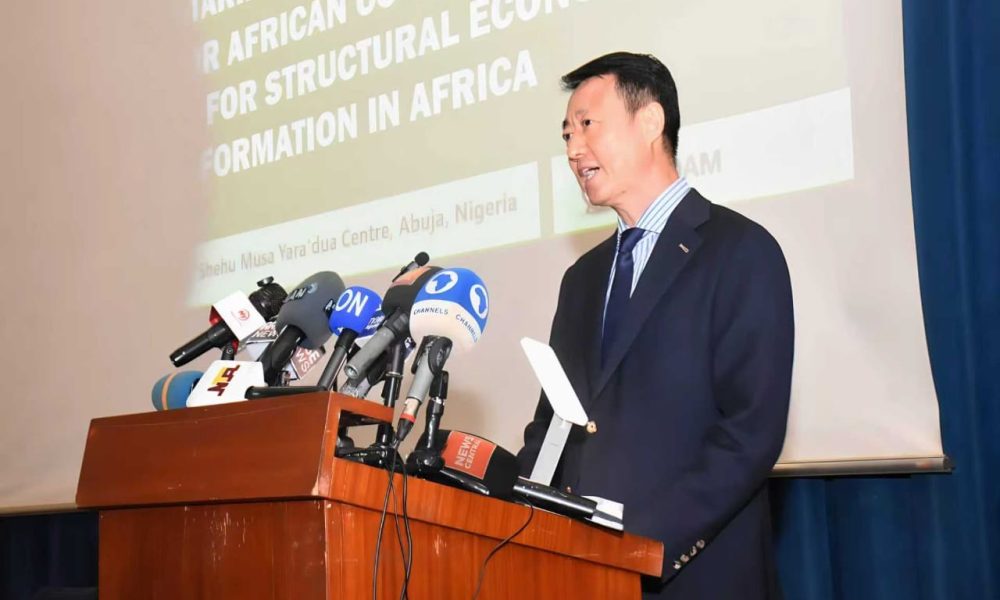
ABUJA — Nigeria’s exports to China jumped by 80 per cent to $2.3 billion in the first half of 2026, following the implementation of China’s zero-tariff policy for African countries, the Chinese Ambassador to Nigeria, Yu Dunhai, has disclosed.
Dunhai made the disclosure at an international seminar on “China’s Zero-Tariff Treatment for African Countries and Its Implications for Structural Economic Transformation of Africa,” held at the Shehu Yar’Adua Conference Centre in Abuja.
The figures were contained in a statement issued on Saturday, August 15, 2026, by Kimiebi Imomotimi Ebienfa, spokesperson for the Ministry of Foreign Affairs, Abuja.
According to the statement, China’s zero-tariff policy took effect on May 1, 2026, with the ambassador reporting significant growth in trade between Nigeria and China since its implementation.
Dunhai said Nigeria-China trade reached $18 billion in the first half of 2026, representing a 35 per cent year-on-year increase.
He added that Chinese imports from Nigeria surged 80 per cent to $2.3 billion, with monthly growth exceeding 40 per cent in May and June.
“Since it took effect, we have seen immediate and concrete results because tariff eliminations are reducing costs, trade volumes are expanding, and local businesses are leveraging zero tariffs to invest in domestic processing and move up the value chain,” Dunhai said.
The development comes as Nigeria pushes African countries to use the tariff concession to move beyond exporting raw materials and instead build manufacturing capacity, expand local processing and develop regional value chains.
Speaking at the seminar, the Permanent Secretary, Ministry of Foreign Affairs, Ambassador Dunoma Umar Ahmed, said the policy represented a strategic opportunity for Africa, but warned that tariff-free access alone would not guarantee structural economic transformation.
“For Nigeria, the central question is not simply how much Africa can export to China, but what Africa will produce, how it will produce it, and how much value will be retained within African economies,” Ahmed said.
He said Nigeria was seeking to move away from dependence on unprocessed commodities under the Renewed Hope Agenda of President Bola Ahmed Tinubu.
“Our natural resources must become the starting point—not the end point—of economic activity,” Ahmed said.
According to him, Nigeria wants to attract investors who will establish factories, develop industries, transfer technology, train young people, strengthen local businesses and create sustainable employment.
Ahmed said Nigeria was well positioned to lead Africa’s industrialisation drive, citing its large market, membership of the African Continental Free Trade Area, entrepreneurial population and abundant natural resources.
Dunhai identified four priorities for maximising the benefits of China’s zero-tariff policy: improving product quality and supply-chain stability, expanding local processing, aligning trade with long-term investment, and strengthening policy outreach to Nigerian small and medium-sized enterprises.
The ambassador also said China was ready to finalise an Agreement on Economic Partnership for Shared Development with Nigeria and support joint industrial parks, technology transfer and training.
Earlier, Charles Onunaiju, Director of the Center for China Studies, said China’s zero-tariff treatment now covers 100 per cent of tariff lines for 53 African countries.
“The zero-tariff treatment is not a finished line but only a starting point,” Onunaiju said, stressing the need for African countries to overcome domestic constraints and use AfCFTA to develop regional value chains.
The seminar brought together manufacturers, farmers, exporters, customs authorities and financial institutions to explore practical ways of turning expanded access to the Chinese market into increased production, investment and value addition.
The Ministry of Foreign Affairs reaffirmed Nigeria’s readiness to work with China, African countries and development partners to translate market access into manufacturing capacity, trade into industrial growth and natural resources into lasting prosperity.