


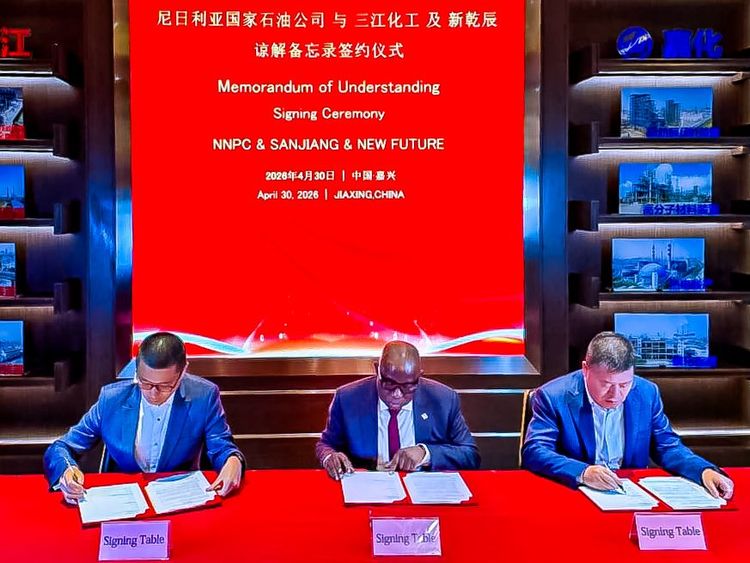
ABUJA — Nigeria’s state oil company, NNPC Limited, has signed a memorandum of understanding (MoU) with two Chinese firms as part of efforts to restart and expand the Port Harcourt and Warri refineries, in a move aimed at strengthening domestic refining capacity and reducing reliance on fuel imports.
The agreement, signed on April 30, 2026, in Jiaxing City, China, involves Sanjiang Chemical Company Limited and Xinganchen (Fuzhou) Industrial Park Operation and Management Co. Ltd. It sets out a framework for a potential technical equity partnership focused on completing, operating, and upgrading the two refineries.
NNPC’s Group Chief Executive Officer, Bashir Bayo Ojulari, signed on behalf of the company, alongside Guan Jianzhong, Chairman of Sanjiang Chemical, and Bill Bi, Chairman of Xinganchen.
According to NNPC, the proposed collaboration will target the completion of outstanding rehabilitation work at both facilities, alongside long-term operations and maintenance designed to achieve “best-in-class” performance standards.
The initiative also includes plans to upgrade the refineries to produce cleaner and more commercially viable petroleum products, aligning with evolving global fuel specifications and environmental benchmarks.
Beyond refining, the partnership signals a broader industrial strategy. The parties are exploring the expansion of petrochemical capacity at both locations, as well as the development of gas-based industrial hubs to leverage Nigeria’s natural gas resources and deepen value addition in the downstream sector.
The proposed technical equity model reflects a shift from state-led refinery management toward partnership-driven operations, aimed at improving efficiency, attracting capital, and ensuring sustainability — a recurring challenge in Nigeria’s refining sector.
Nigeria has long struggled with underperforming refineries despite multiple rehabilitation efforts. The Port Harcourt and Warri facilities have operated below capacity for years, contributing to the country’s dependence on imported refined products even as a major crude oil producer.
Ojulari described the agreement as a milestone following months of engagement between NNPC and the Chinese firms, noting that all parties see long-term commercial potential in Nigeria’s refining assets.
“All parties recognise mutually beneficial opportunities for the development and sustainable profitability of NNPC’s refining assets,” he said.
He added that the MoU represents a step toward identifying suitable technical equity partners capable of supporting the restart and expansion of the refineries, while also unlocking opportunities in petrochemicals and gas-based industries.
The agreement, however, remains at a preliminary stage. NNPC noted that the MoU reflects an intention to continue discussions, with any binding commitments subject to further negotiations and regulatory approvals.
The development comes amid broader efforts by Nigeria to reposition its downstream oil sector, including increased private sector participation and ongoing investments such as the Dangote Refinery..