


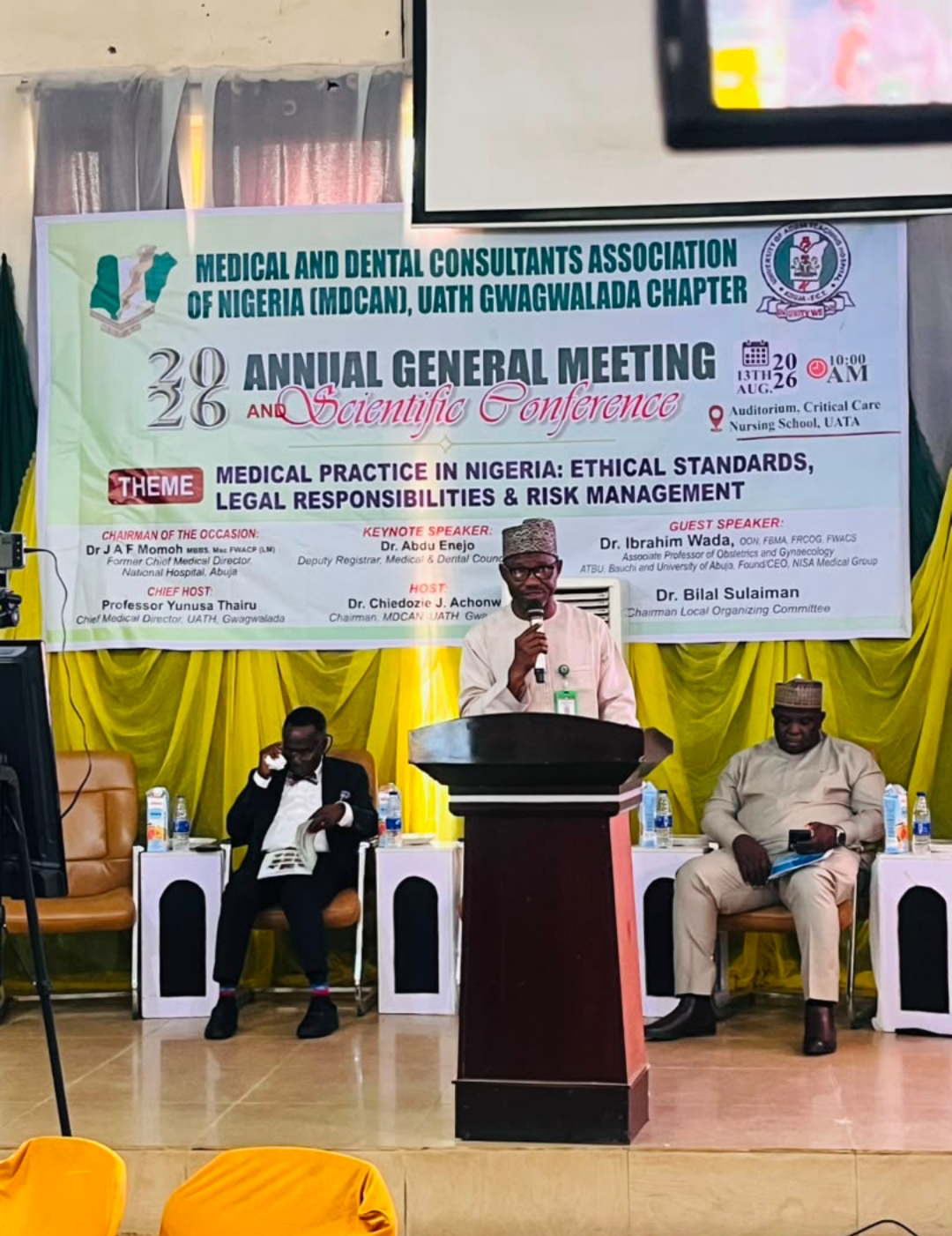
The Medical and Dental Council of Nigeria (MDCN) has revealed that most petitions against medical practitioners are not triggered by lack of clinical knowledge, but by ethical breaches, poor communication, inadequate documentation, consent problems and weak supervision.
The Council’s Deputy Registrar and Director of Professional Discipline, Dr Enejo D. Abdu, disclosed this in Abuja while speaking at the Annual General Meeting of the Medical and Dental Consultants’ Association of Nigeria (MDCAN), University of Abuja Teaching Hospital (UATH) Branch.
Abdu, who spoke on “Medical Practice in Nigeria: Ethical Standards, Legal Responsibilities and Risk Management,” warned that even experienced medical consultants could face disciplinary and legal consequences when they fail to observe professional ethics and proper risk-management procedures.
He said: “Our colleagues rarely fall because they did not know medicine. They fall because they did not attend to ethics, to law, and to risk.”
According to him, consultants face particular professional risks because they are the final clinical authorities in their units and are responsible for supervising residents and house officers.
He explained that, where appropriate, errors committed by junior doctors under a consultant’s supervision could have consequences for the senior doctor.
Abdu identified informed consent, patient abandonment, disparaging colleagues before patients, poor supervision and false or negligently prepared medical reports among the recurring issues brought before the Council.
On informed consent, he warned doctors that getting a patient to sign a form does not automatically amount to consent.
He said patients must understand their diagnosis, proposed treatment, material risks and available alternatives before agreeing to a medical procedure.
The MDCN official particularly frowned on the practice of obtaining signatures from patients who had already been premedicated shortly before surgery, describing such action as “mere paperwork” rather than genuine informed consent.
He also warned doctors against “medical jousting” — publicly discrediting the treatment or professional judgment of another doctor in the presence of patients.
According to him, disagreements over clinical decisions should be addressed through clinical audits, morbidity reviews and other established professional processes.
Abdu further warned that professional misconduct could expose doctors to multiple consequences, including disciplinary proceedings, civil claims, criminal prosecution and employment sanctions.
He said penalties from the Council could range from admonition to suspension and, in serious cases, removal of a practitioner’s name from the professional register.
He also stressed that medical negligence claims could result in financial damages and, in certain circumstances, criminal liability.
The MDCN director emphasised the importance of proper medical documentation, noting that patients’ records could become crucial evidence during disciplinary proceedings and medical negligence cases.
He cited Supreme Court decisions, including Medical and Dental Practitioners Disciplinary Tribunal v. Okonkwo and Ojo v. Gharoro, as examples highlighting patient autonomy, surgical errors and the importance of medical records.
Abdu said the responsibilities of doctors had expanded beyond conventional negligence issues to include patients’ rights to information, confidentiality, emergency care and participation in decisions concerning their treatment.
He also cautioned practitioners against careless handling of patients’ health information through informal digital platforms, stressing the need for proper security and controlled access to medical records.
On telemedicine, he said the use of digital platforms had not lowered the standard of care expected from doctors, adding that practitioners remained accountable for medical decisions made during remote consultations.
He urged consultants to make proper documentation, informed consent, effective communication, adequate supervision and timely referral part of their routine practice.
Abdu also called on doctors to ensure that laboratory and imaging results were reviewed and acted upon promptly, while advising them to maintain professional indemnity insurance, protect patient records and keep their practising licences and professional certifications up to date.
He disclosed that some petitions before the Council involved medical investigations that had been ordered, received and filed but were never reviewed by the responsible practitioners.
He therefore urged consultants and hospitals to establish systems capable of flagging unreviewed test results.
Abdu said the MDCN should not be viewed mainly as a prosecutorial body, stressing that its wider responsibility was to protect the public by promoting higher professional standards.
He said education, standard-setting and engagement remained critical components of the Council’s regulatory mandate, with disciplinary action serving as a last resort.
He challenged the MDCAN UATH branch to conduct periodic medico-legal audits covering consent procedures, medical records and systems for tracking investigation results.
He also called for institutionalised mentorship in professionalism, urging consultants to teach residents ethical practice through their conduct and everyday interactions.
Abdu said modern medical consultants must combine clinical expertise with a strong understanding of their legal and ethical responsibilities.
“The consultant of 2026 must carry both with equal facility, not out of fear of the courtroom or the Tribunal, but out of fidelity to the oldest promise of our calling: first, do no harm to the patient, to the profession, and to oneself,” he said.
Earlier, Chairman of the Local Organising Committee and Vice Chairman of MDCAN, UATH Branch, Dr Bilal Sulaiman, said the conference was organised to enable medical consultants to examine the changing healthcare landscape while strengthening professional competence and collaboration.
Sulaiman said the growing complexity of healthcare delivery required consultants to combine clinical excellence with strict adherence to ethical standards, knowledge of legal responsibilities and effective risk management.
He said the conference would provide participants with opportunities to exchange experiences, update their knowledge and develop practical solutions to challenges facing medical practice in Nigeria.
He also expressed appreciation to the Chief Medical Director of the University of Abuja Teaching Hospital, Prof. Thairu Yunusa, hospital management, MDCAN UATH Branch Chairman, Dr C.J. Achonwa, members of the executive council and other stakeholders for supporting the event.